How to Identify a Maple Tree — 3 Quick Features
Identifying a tree as a maple is one of the easiest tasks in tree identification. Maples have three features so distinctive that any one of them immediately identifies the genus: opposite leaves, lobed leaf shape, and paired winged seeds (samaras). If you find a tree with any of these features, check the others — if two or all three are present, you have found a maple with near certainty.
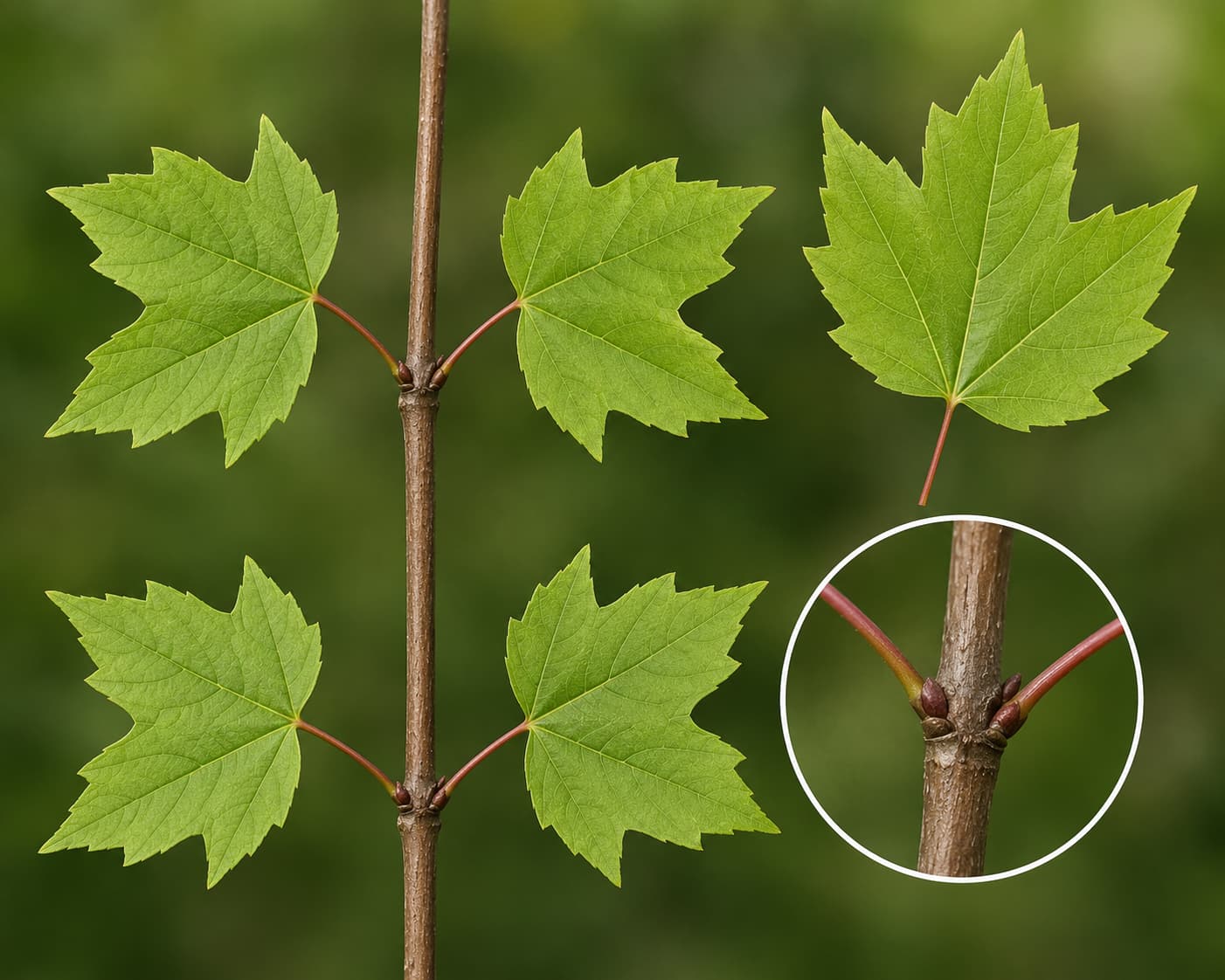
The most useful quick identification feature is the opposite leaf arrangement — two leaves growing directly across from each other at each node on the twig. Among lobed-leaf trees, opposite arrangement is almost exclusively a maple feature. Oak, birch, and most other lobed-leaf trees have alternate leaves. When you see opposite lobed leaves, think maple first. Use our dedicated Maple Tree Identifier to confirm the specific species from a photo in seconds.
6 Key Features for Maple Identification
Once you have confirmed a tree is a maple, these six features help identify the specific species. Observe them in order from most to least diagnostic for the fastest accurate identification.
Two leaves grow directly across from each other at each node — the single fastest way to identify maples. Only Maple, Ash, Dogwood, and a few others have opposite leaves.
Most maples have 3-5 finger-like lobes. Sinus depth varies — shallow in Sugar Maple, very deep in Silver Maple. Box Elder is the exception with compound leaves.
Multiple main veins radiate from the leaf base, one to each lobe — like fingers spreading from a palm. Clearly visible when leaf is held up to light.
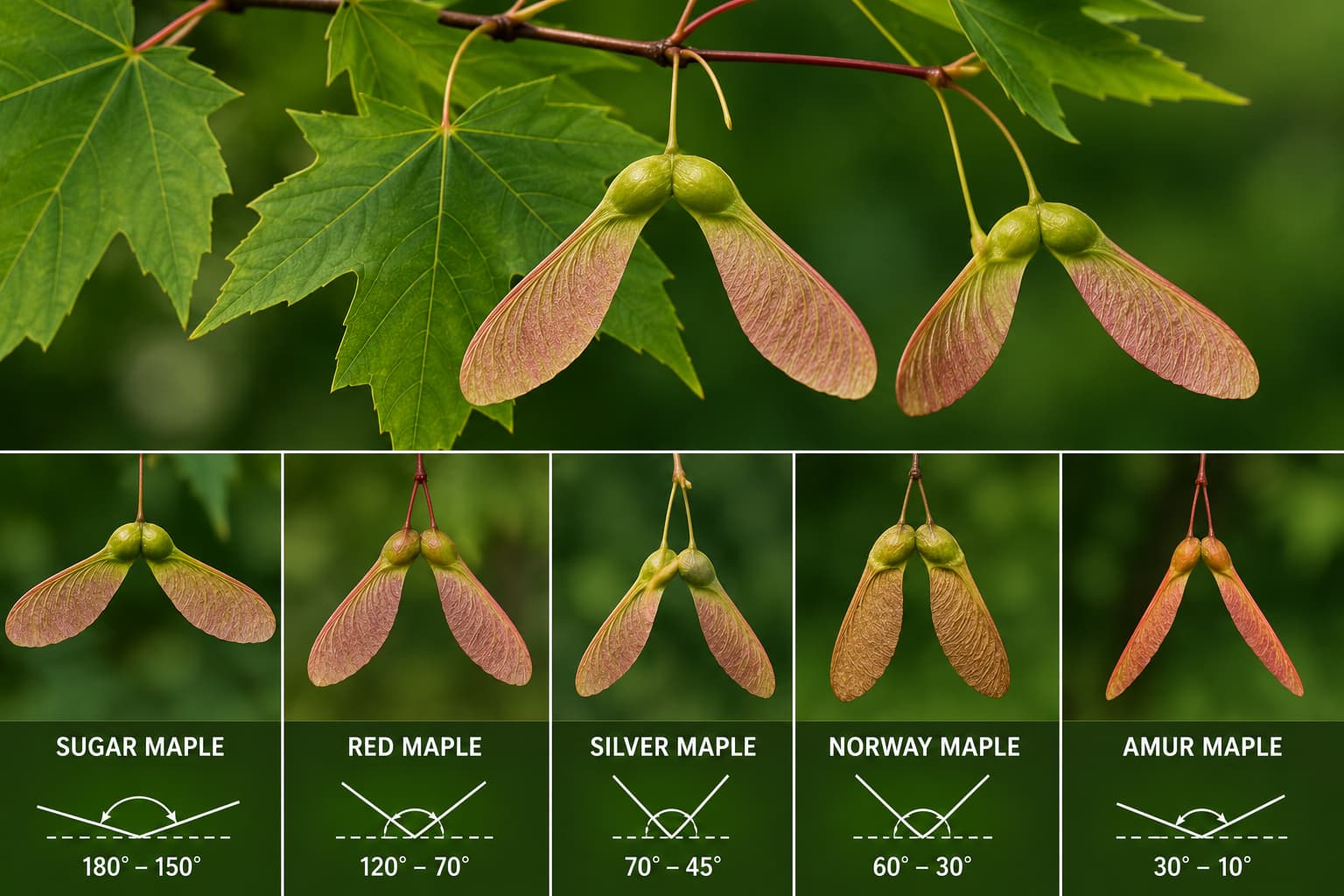
Paired winged seeds (helicopters) are found only on maples. The angle between the two wings varies by species and helps identify specific maples.
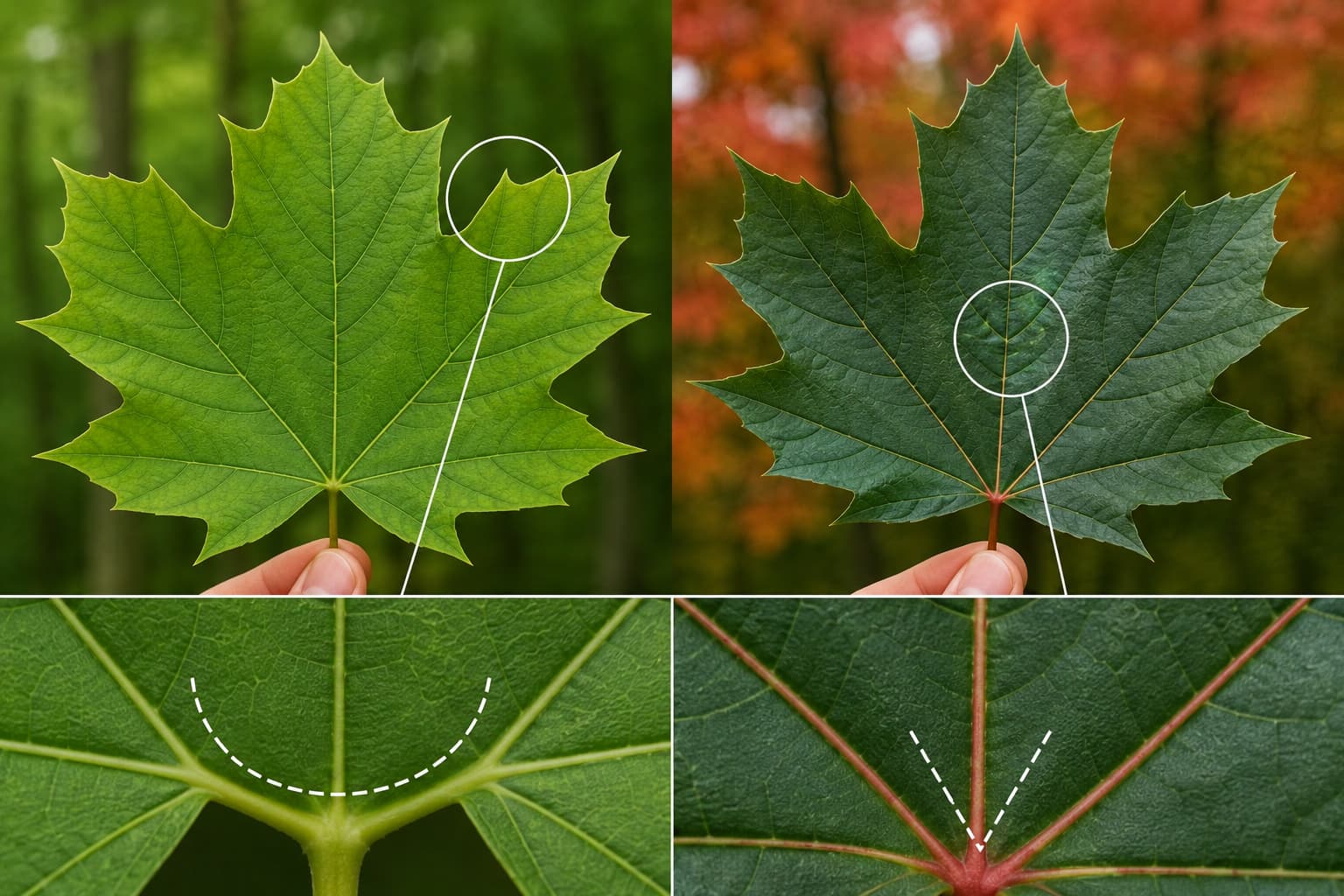
The spaces between lobes distinguish species: U-shaped sinuses = Sugar Maple. V-shaped sinuses = Red Maple. Very deep sinuses nearly to midrib = Silver Maple.
Check the leaf underside. Silver Maple has brilliant silvery-white underside. Sugar Maple is pale green below. Red Maple may have whitish underside with tufts of hair at vein junctions.
Sugar Maple vs Red Maple — The Most Important Distinction
Sugar Maple and Red Maple are the two most abundant maple species in eastern North America and are frequently confused. Learning to distinguish them reliably is the most important maple identification skill for anyone in the eastern United States or Canada. The differences are subtle but consistent once you know what to look for.
The most reliable single feature is the sinus shape — the space between the leaf lobes. In Sugar Maple, sinuses are U-shaped — the bottom of the space between lobes is rounded. In Red Maple, sinuses are V-shaped — the bottom of the space is sharply angular. This difference is visible on every leaf and consistent across all specimens. Check it by looking at the junction between two lobes and asking: is the base of that space rounded (U) or pointed (V)?
Secondary distinguishing features include leaf stalk color (Red Maple has a distinctly reddish petiole, Sugar Maple's is green to tan), bark texture (Sugar Maple bark has long slightly curling plates, Red Maple bark is smoother and scalier), seed timing (Red Maple samaras ripen and fall in spring — early May in the northeast — while Sugar Maple samaras ripen in autumn), and fall color timing (Red Maple colors up earlier in autumn, often by early September, while Sugar Maple peaks in October).
8 Maple Species — Complete Identification Profiles
The following profiles cover the 8 most important maple species in North America, with identification features for leaf, bark, seeds, and fall color for each species.
#1 Sugar Maple
Acer saccharum · NE North America
#2 Red Maple
Acer rubrum · Eastern North America
#3 Silver Maple
Acer saccharinum · Eastern North America
#4 Norway Maple
Acer platanoides · Introduced from Europe — widely planted
#5 Box Elder
Acer negundo · Central & Eastern North America
#6 Bigleaf Maple
Acer macrophyllum · Pacific Coast North America
#7 Striped Maple
Acer pensylvanicum · NE North America
#8 Mountain Maple
Acer spicatum · NE North America
Maple Tree Identification in Winter
Maple trees are identifiable in winter even without leaves due to several distinctive features. The opposite bud arrangement on twigs — a direct reflection of the opposite leaf arrangement — immediately identifies maples and a small number of other genera (ash, dogwood). Maple buds are typically reddish to brown and pointed, arranged in opposing pairs along the twig.
Red Maple is one of the earliest-flowering trees in the northeast, producing small clusters of red flowers in late February to March, often while snow is still on the ground. These red flowers on bare branches are unmistakable and provide very early spring identification. Red Maple samaras ripen in May — finding small paired winged seeds on the ground in spring strongly suggests Red Maple.
Silver Maple bark becomes distinctively shaggy on mature trees, with long strips peeling away from the trunk — visible in winter and identifiable from a distance. Striped Maple's green-and-white striped bark is unmistakable at any season. For more winter identification strategies, see our complete winter tree identification guide.
Maple Trees and Fall Color
Maple trees are among the most important contributors to autumn foliage displays across North America and have made regions like New England and eastern Canada internationally famous for fall color tourism. Understanding which maple species produces which colors helps both identify maples in autumn and predict where the best fall color will occur.
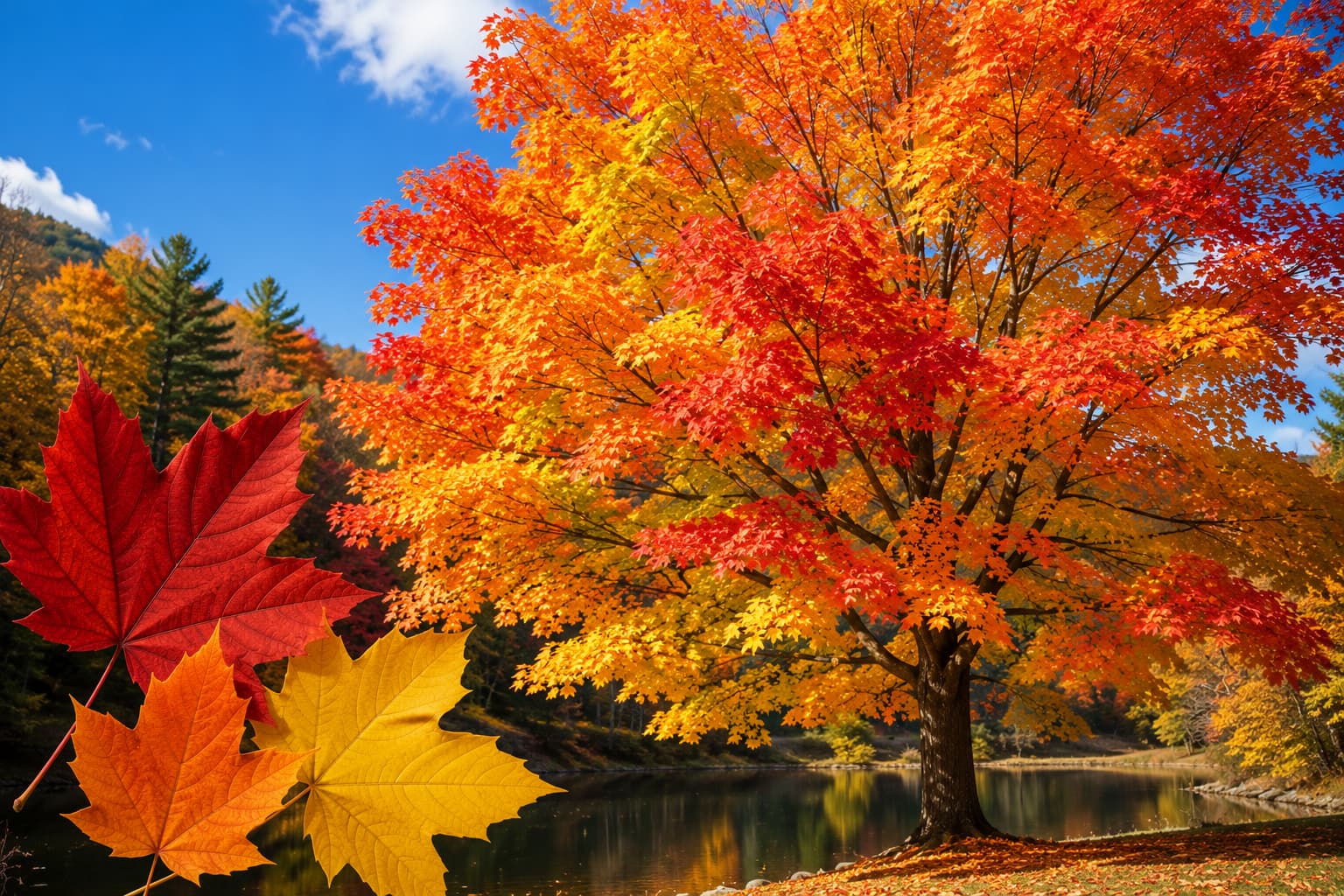
Sugar Maple produces the most spectacular and varied fall color of any North American tree — a single tree can display yellow, orange, and red simultaneously, with the colors changing daily as autumn progresses. The peak of Sugar Maple color typically occurs in early to mid-October in New England, slightly later further south. Red Maple, as its name suggests, typically turns brilliant red, though some individuals produce orange or yellow. Importantly, Red Maple colors up earlier than Sugar Maple — often by mid-September in the northern part of its range — giving leaf peepers an early-season show before the main Sugar Maple peak.
Silver Maple produces relatively undramatic pale yellow fall color, while Box Elder turns yellow. Striped Maple and Mountain Maple turn bright yellow. Norway Maple turns yellow, typically later than native maples. Purple-leaved cultivars of Norway Maple (such as 'Crimson King') maintain their dark red-purple color all season before turning dull in autumn.
Frequently Asked Questions — Maple Tree Identification
How do I identify a maple tree?
Look for opposite lobed leaves (two leaves directly across from each other at each node), 3-5 lobes, and paired helicopter seeds (samaras). If a tree has opposite lobed leaves and helicopter seeds, it is almost certainly a maple.
What is the difference between Sugar Maple and Red Maple?
Sugar Maple has U-shaped sinuses (rounded spaces between lobes), green leaf stalks, and brilliant orange-yellow fall color. Red Maple has V-shaped sinuses (pointed spaces between lobes), reddish leaf stalks, and bright red fall color that appears earlier in autumn.
How do I identify maple leaves?
Maple leaves are opposite on the twig, have 3-5 pointed lobes, palmate venation, and a long leaf stalk. Sinus shape (U = Sugar Maple, V = Red Maple, very deep = Silver Maple) is the most reliable feature for identifying specific maple species.
What do maple seeds look like?
Maple seeds are paired winged fruits called samaras (helicopters/whirlybirds). Two seeds join at their base with papery wings attached. The angle between the wings varies by species — this helps identify specific maples.
How do I identify a Silver Maple?
Silver Maple has very deeply cut leaves with sinuses nearly reaching the midrib, brilliant silvery-white leaf undersides that flash in the wind, and shaggy peeling bark on mature trees. It commonly grows near water.
How many maple species are there?
About 132 species worldwide, with 13 native to North America. Most common: Sugar Maple, Red Maple, Silver Maple, Box Elder (only compound-leaved maple), Norway Maple, Bigleaf Maple, Striped Maple, and Mountain Maple.
What maple tree has the best fall color?
Sugar Maple produces the most spectacular fall color — brilliant orange, yellow, and red simultaneously. Red Maple turns bright scarlet earlier in the season. Both are excellent fall color trees.
Use AI to Identify Maple Trees Instantly
Our dedicated Maple Tree Identifier is specifically optimized for maple species identification. Upload a photo of maple leaves, bark, samaras, or the whole tree and receive instant species identification. The AI distinguishes between all common maple species including difficult pairs like Sugar vs Red Maple and Norway vs Sugar Maple.
For general tree identification, use our AI Tree Identifier. For leaf-specific identification, our Leaf Identifier provides detailed leaf analysis. Related guides: Oak Tree Identification Guide, How to Identify Trees by Leaves, Tree Identification by Bark, and Winter Tree Identification.
For other species identifiers, see: Oak Tree Identifier, Pine Tree Identifier, Birch Tree Identifier, and Palm Tree Identifier.