The Complete Guide to Elm Tree Identification
Elm trees are among the most graceful and historically significant trees in the Northern Hemisphere. Belonging to the genus Ulmus in the family Ulmaceae, there are approximately 35-40 species of elm worldwide, native to temperate regions of North America, Europe, and Asia. Our free AI Elm Tree Identifier makes it simple to identify any elm species from a single photograph, providing expert-level botanical identification instantly and at no cost.
How to Identify Elm Trees — Key Features
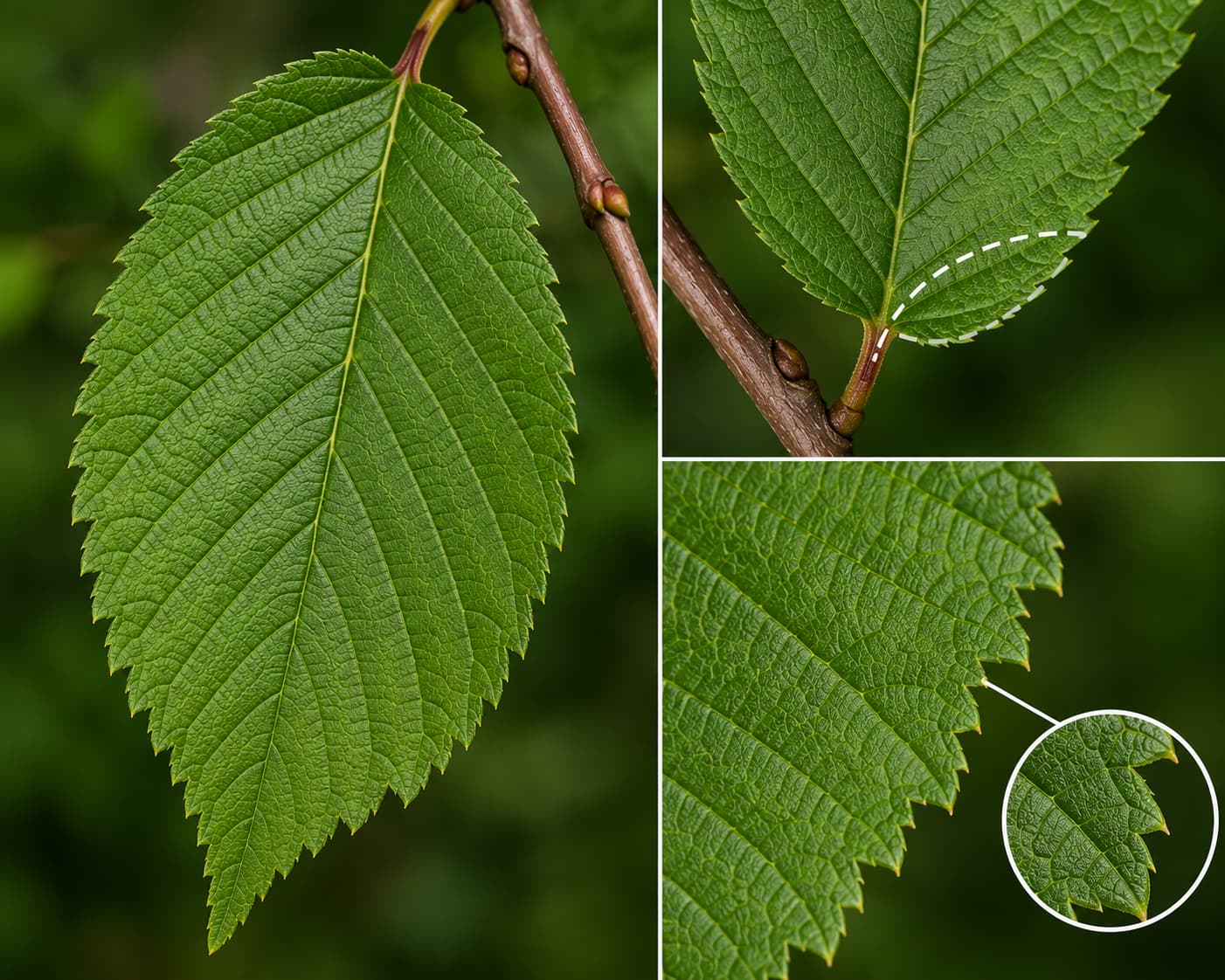
Elm trees have several highly distinctive features that make identification straightforward once you know what to look for. The single most reliable elm identification feature is the asymmetric leaf base — when you look at an elm leaf, one side of the base where the leaf attaches to its stalk is noticeably higher than the other. This lopsided base is found in all elm species and distinguishes elms from nearly all other common trees. Run your finger across the two sides of the leaf base — you can feel the height difference even without looking closely.
The doubly serrated leaf margin is the second key feature. Elm leaf edges have alternating large and small teeth — a large tooth followed by a small tooth, consistently around the entire leaf margin. This pattern distinguishes elms from trees with simply serrated leaves (one size of teeth) and from trees with smooth leaf margins. Combined with the asymmetric base, these two features identify any leaf as an elm leaf with near certainty.
Elm leaves are also alternate on the twig — one leaf per node, alternating sides — and have prominent pinnate venation with parallel side veins running to each tooth. The leaf surface texture varies significantly between species: American Elm leaves are slightly rough on top, Slippery Elm leaves are extremely rough like coarse sandpaper, and Chinese Elm leaves are smooth and glossy.
American Elm — The Iconic Vase Tree
American Elm (Ulmus americana) was once the most widely planted street tree in North America and remains one of the most recognizable trees on the continent despite massive losses to Dutch Elm Disease. Its most distinctive feature is the vase-shaped crown — a tall straight trunk that divides into large ascending branches that spread wide at the top, creating a graceful arching canopy. This silhouette is visible from a great distance and is unlike any other North American tree.
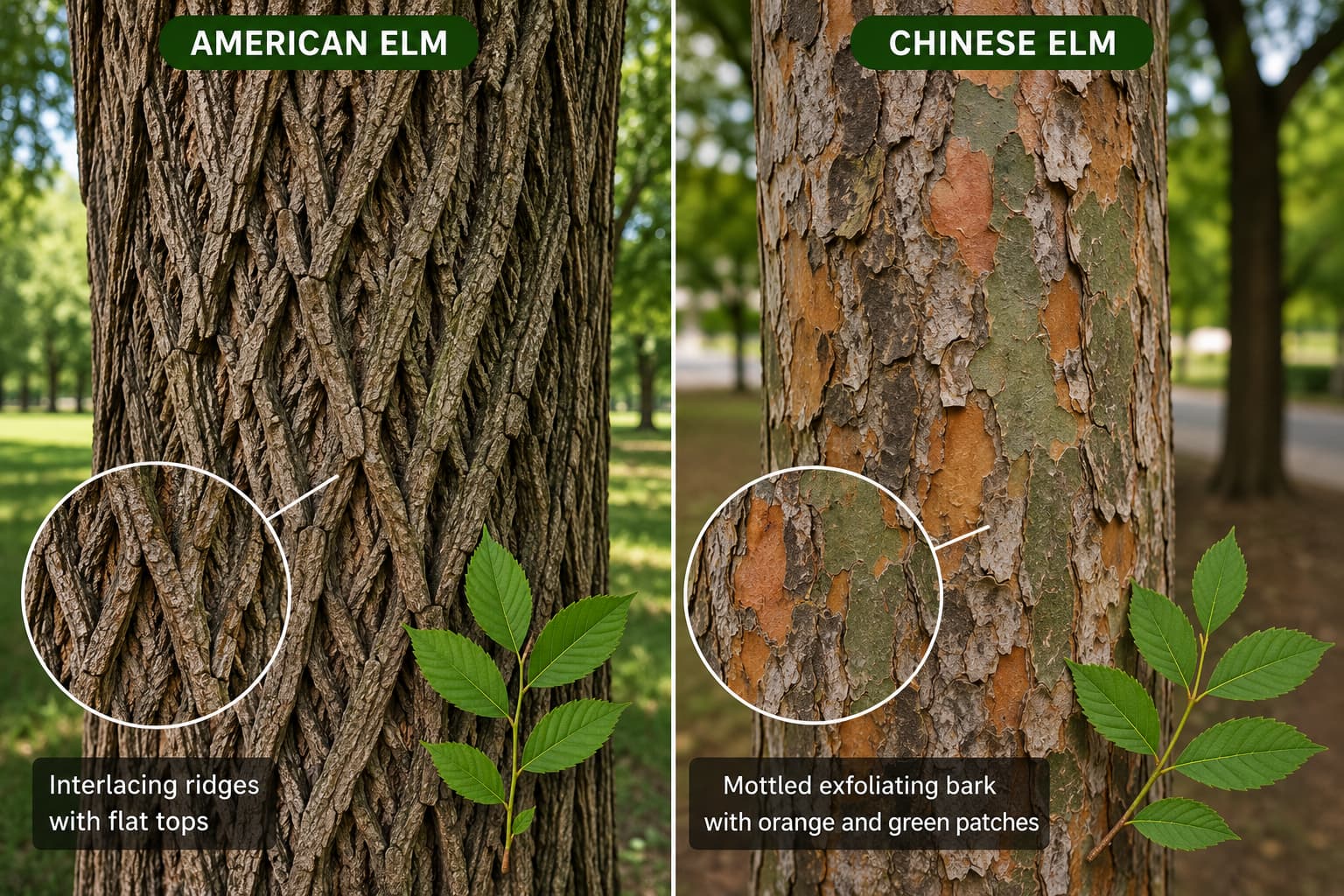
American Elm leaves are oval, 8-15cm long, with the characteristic asymmetric base, doubly serrated margin, and slightly rough upper surface. The bark of mature American Elms is gray-brown with interlacing flat-topped ridges separated by diamond-shaped furrows. In early spring before leaves emerge, American Elm produces small clusters of purplish-red flowers, followed by round flat seeds (samaras) with a papery wing completely surrounding the seed — appearing in April or May.
Dutch Elm Disease has eliminated most large American Elms from North American cities and forests. Disease-resistant cultivars including 'Princeton', 'Valley Forge', and 'New Harmony' are now available and widely planted, offering the same beautiful vase form with significantly improved disease resistance.
Slippery Elm — The Medicinal Elm
Slippery Elm (Ulmus rubra) is distinguished from American Elm by several reliable features. Most notably, its upper leaf surface is extremely rough — noticeably rougher than American Elm and described as coarse sandpaper. This tactile feature is immediately apparent when you touch the leaf. Slippery Elm leaves are also generally larger (10-18cm) and have a somewhat rougher texture overall.
The name "Slippery Elm" refers to the inner bark, which is mucilaginous — slippery and gel-like when wet. Native American peoples and early settlers used Slippery Elm inner bark as a medicinal food and for treating various ailments. The inner bark remains available as a herbal supplement today. Identifying Slippery Elm by its inner bark requires scratching through the outer bark and wetting the exposed inner layer to observe the mucilaginous texture.
Chinese Elm — The Ornamental Elm
Chinese Elm (Ulmus parvifolia) is one of the most widely planted ornamental elms worldwide and differs significantly from North American species in several ways. Its leaves are much smaller (2-5cm), glossy rather than rough, and it is semi-evergreen in mild climates. Most distinctively, Chinese Elm has mottled exfoliating bark — the outer bark flakes off in irregular patches revealing a mosaic of orange, gray, brown, and green beneath, making it one of the most ornamental tree barks of any species.
Chinese Elm is significantly more resistant to Dutch Elm Disease than American or English Elm and tolerates urban conditions, drought, and pollution well. These qualities make it a popular choice for street plantings, gardens, and bonsai cultivation. It can be distinguished from Siberian Elm (often mislabeled as "Chinese Elm" in nurseries) by its smaller leaves, better form, and superior ornamental bark.
Elm Tree Identification by Bark
Elm bark identification is particularly valuable in winter when leaves are absent. American Elm bark on mature trees is gray-brown with a distinctive pattern of interlacing flat-topped ridges separated by diamond-shaped furrows — different from the vertical ridges of oaks or the plated bark of maples. The ridges often appear to cross each other in an interlacing network pattern.
Rock Elm (Ulmus thomasii) and Winged Elm (Ulmus alata) both produce distinctive corky growths on their branches — irregular cork-like wings running along the sides of smaller branches. These corky wings are year-round features that immediately identify these two species even in winter. For bark-based elm identification, see our complete bark identification guide.
Elm Seeds — Identification from Samaras
Elm seeds are flat, circular, winged fruits called samaras, with the papery wing completely surrounding the central seed — unlike maple samaras where the wing is attached to one side only. American Elm samaras are 1-1.5cm across with a distinctive notch at the top. They are produced abundantly in early spring (April-May in the northeast) before the leaves fully emerge, carpeting the ground beneath elm trees with a green then pale tan layer of seeds.
The timing of elm seed production — early spring before leaves — is an identification clue in itself. Finding large quantities of circular flat winged seeds beneath a tree in April suggests elm. Slippery Elm samaras are similar but slightly larger and have a reddish-tinged wing. Chinese Elm produces much smaller samaras (0.8-1.2cm) in autumn rather than spring — a significant difference in timing that helps identify this species.
Dutch Elm Disease — Impact and Identification
Dutch Elm Disease (DED) has profoundly changed elm populations across North America and Europe. Caused by the fungus Ophiostoma novo-ulmi and spread by elm bark beetles, DED has killed an estimated 40 million American Elms in North America since the 1960s. Understanding DED symptoms helps identify affected trees and distinguish disease damage from other causes.
The earliest DED symptom is flagging — one or a few branches suddenly wilting and yellowing while the rest of the tree remains green, typically first appearing in summer. If the bark of a wilting branch is peeled back, brown streaking in the sapwood (the outer wood layer) is the definitive confirmation of DED. Once established, DED typically kills most of the crown within one to three years. Early detection and prompt removal of affected branches can sometimes slow spread, but established infections are difficult to control.
Using Our Elm Tree Identifier
Our AI Elm Tree Identifier uses advanced computer vision trained on thousands of elm tree photographs to deliver accurate species identification. For best results, photograph a single mature undamaged leaf from directly above on a light background, ensuring the full leaf blade including the base is clearly visible — the asymmetric base is the most important feature for the AI to analyze.
For bark photos, stand 30-40cm from the trunk and shoot straight-on in natural side lighting. Include a full-tree silhouette photo when possible — the distinctive vase shape of American Elm is instantly recognizable to the AI. For winter identification, bark photos combined with any visible branch features (corky wings in Rock or Winged Elm) provide the best results. Simply upload your photo and get your result in seconds.
Related identification tools: Oak Tree Identifier, Maple Tree Identifier, Birch Tree Identifier, Pine Tree Identifier. For leaf-specific identification see our Leaf Identifier. For more guides, visit our Tree Identification Blog including our winter tree identification guide and bark identification guide.