What Does a Heart Shaped Tree Leaf Look Like?
In botanical terms, a heart-shaped leaf is called cordate (from the Latin cor, meaning heart). A cordate leaf has a broad rounded outline with a characteristic notch — called a sinus — at the base where the leaf stalk (petiole) attaches to the blade. This creates the two rounded lobes at the base of the leaf that form the top of the heart shape, while the leaf narrows to a pointed tip at the other end.
Heart-shaped leaves vary enormously in size across different tree species — from the tiny 3cm leaves of Katsura to the enormous 60cm leaves of young Paulownia trees. They also vary in margin type (smooth edges vs. toothed edges), surface texture (glossy, rough, or hairy), and base symmetry (perfectly symmetric in Redbud, or asymmetric in Basswood and Hackberry). These additional features are what distinguish one heart-leaved tree from another. Upload a photo to our AI Leaf Identifier for instant identification.

Quick Identification Guide — Heart Shaped Leaf Trees
Before diving into full species profiles, use this quick guide to narrow down your identification. The two most important features to observe are leaf size and leaf margin (edge):
Trees With Heart Shaped Leaves — Smooth Margins (No Teeth)
Trees with smooth-edged heart-shaped leaves include some of the most beautiful and distinctive ornamental trees. If your heart-shaped leaf has completely smooth edges with no teeth or serrations, these are the most likely candidates.
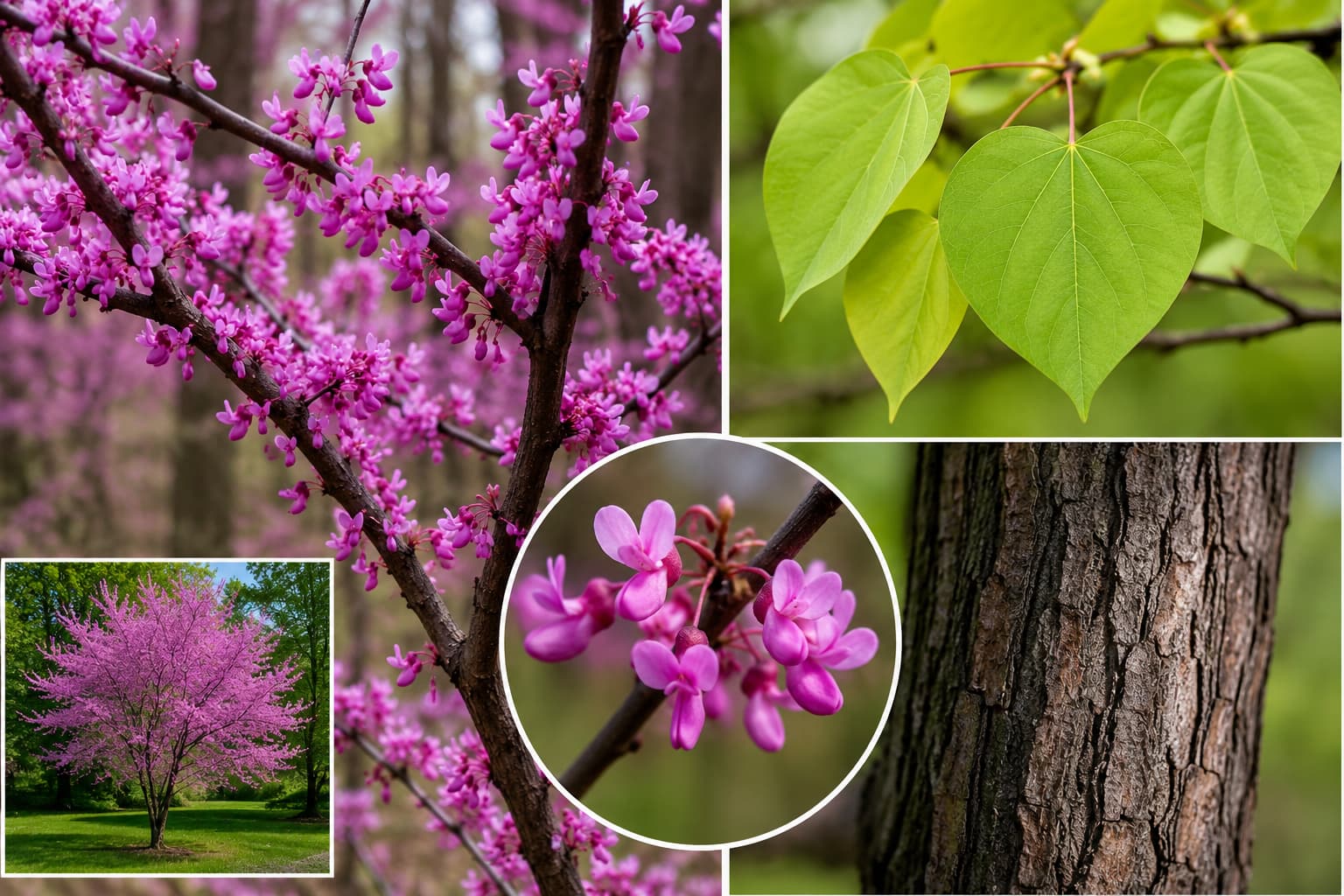
Eastern Redbud
Smooth MarginVery EasyCercis canadensis · Eastern North America
Northern Catalpa
Smooth MarginVery EasyCatalpa speciosa · Central & Eastern North America
Paulownia / Empress Tree
Smooth MarginVery EasyPaulownia tomentosa · Asia (widely naturalized)
Katsura Tree
Smooth MarginEasyCercidiphyllum japonicum · Japan & China (widely planted)
Lilac
Smooth MarginVery EasySyringa vulgaris · Europe (widely planted worldwide)
Judas Tree
Smooth MarginEasyCercis siliquastrum · Southern Europe & Western Asia
Teak
Smooth MarginEasy (in tropical regions)Tectona grandis · South & Southeast Asia
Cercis / Chinese Redbud
Smooth MarginEasyCercis chinensis · China (widely planted)
Trees With Heart Shaped Serrated Leaves (Toothed Edges)
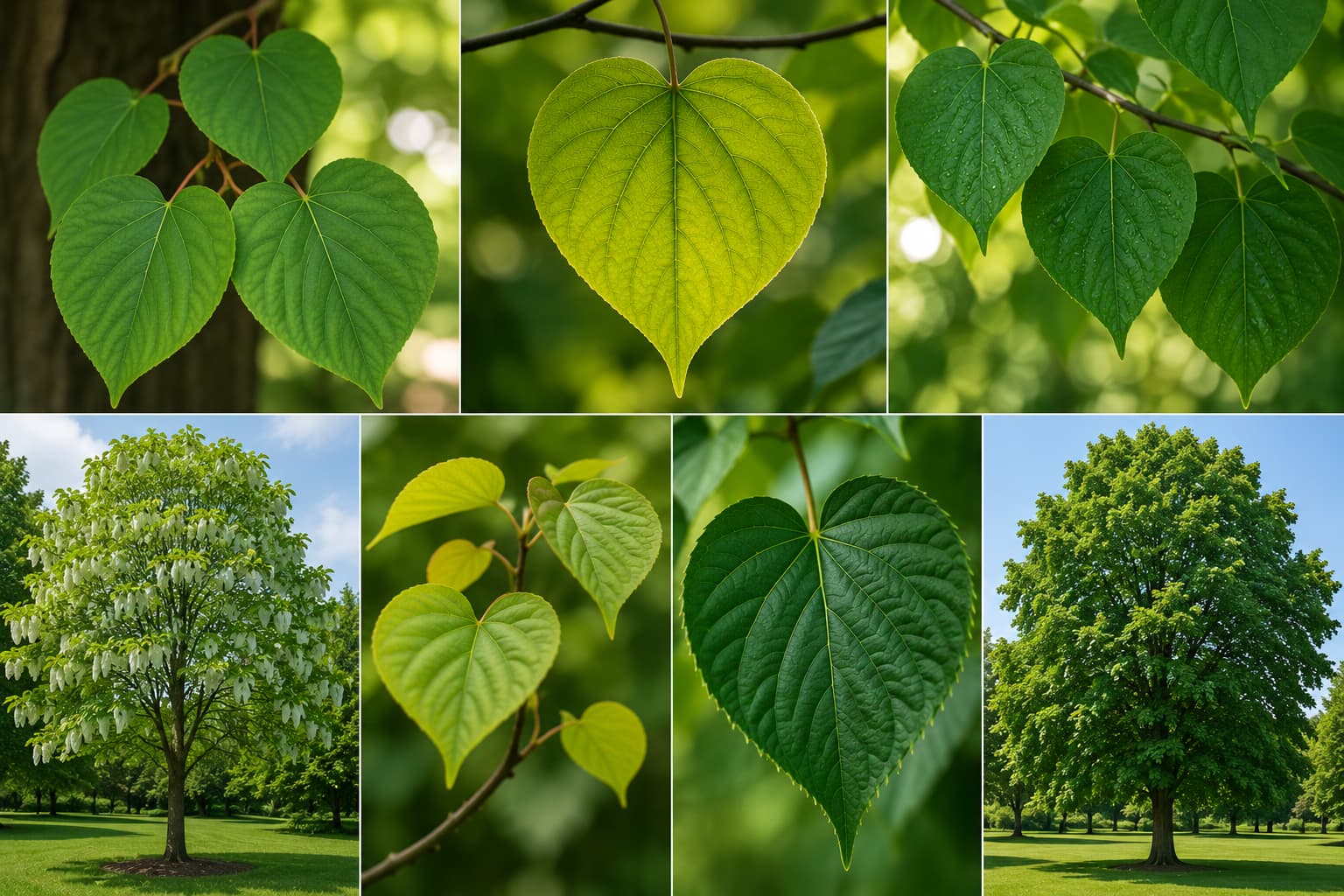
If your heart-shaped leaf has teeth or serrations along the edges, these species are the most likely candidates. Heart-shaped serrated leaves are common in several important North American trees and can be distinguished from each other by leaf size, base symmetry, and bark features.
American Basswood / Linden
Serrated MarginEasyTilia americana · Eastern North America
Hackberry
Serrated MarginEasyCeltis occidentalis · Eastern North America
Mulberry
Serrated MarginMediumMorus alba / rubra · Worldwide (temperate)
Cottonwood / Poplar
Serrated MarginEasyPopulus deltoides / nigra · North America & Europe

Large Trees With Heart Shaped Leaves
If you are looking at a large mature tree with heart-shaped leaves, the most likely candidates are Catalpa, Paulownia, Basswood, and Cottonwood. Each of these can reach significant size — Basswood and Catalpa can exceed 25 meters, Cottonwood can reach 35 meters, and Paulownia is one of the fastest-growing trees in the world reaching 15 meters in just a few years.
Northern Catalpa (Catalpa speciosa) produces the largest heart-shaped leaves of any common North American tree, with leaves reaching 30cm — larger than your hand with fingers spread. The leaves of Catalpa are also arranged in whorls of three at each node — two or three leaves at the same point on the twig — which is an unusual arrangement that helps distinguish Catalpa from other large-leaved trees. The distinctive cigar-like seed pods (30-50cm long) that persist on the tree through winter are unmistakable and provide year-round identification.
Paulownia (Paulownia tomentosa) produces even larger leaves — up to 60cm on young or coppiced trees, making it the largest-leaved temperate tree in the world. Mature Paulownia trees produce lavender-purple trumpet flowers in spectacular upright clusters before the leaves emerge in spring, one of the most beautiful of all flowering trees. Young Paulownia that has been cut back (coppiced) produces extraordinarily large leaves on vigorous new shoots — leaves this large from a temperate tree are unique to Paulownia.
Small Trees and Shrubs With Heart Shaped Leaves
Several smaller trees and shrubs produce distinctive heart-shaped leaves and are commonly found in gardens and natural areas. Eastern Redbud (Cercis canadensis) is the most beloved of these — a small tree typically reaching 6-10 meters with perfectly heart-shaped smooth leaves and spectacular reddish-purple flowers that appear directly on the branches and trunk before the leaves emerge in early spring. This flowering habit — called cauliflory — makes Redbud unmistakable in spring and one of the most ornamental small trees in North American gardens.
Katsura (Cercidiphyllum japonicum) is a medium-sized tree with small (3-8cm) heart-shaped leaves that are among the most distinctive of any tree in autumn — as the leaves fall, they release a fragrance of burnt caramel, cotton candy, or brown sugar that perfumes the air around the tree. No other common tree has this distinctive autumn scent, making Katsura identifiable by smell alone in autumn. Katsura leaves are opposite on the twig (two leaves per node directly across from each other), which helps distinguish them from alternate-leaved heart-leaved trees like Redbud.
How to Identify a Tree With Heart Shaped Leaves — Step by Step
When you find a heart-shaped leaf and want to identify it, follow these steps in order for the fastest accurate identification:
Step 1 — Measure the leaf size. Large (over 15cm) = likely Catalpa, Paulownia, or Basswood. Medium (8-15cm) = likely Redbud, Hackberry, or Basswood. Small (under 8cm) = likely Katsura, Lilac, or Chinese Redbud.
Step 2 — Check the leaf margin (edge). Smooth with no teeth = Redbud, Catalpa, Paulownia, Katsura, or Lilac. Toothed or serrated = Basswood, Hackberry, Mulberry, or Cottonwood.
Step 3 — Check leaf arrangement on the twig. Two leaves directly across from each other (opposite) = Paulownia, Katsura, or Lilac. Three leaves at same point (whorled) = Catalpa. One leaf per node alternating sides (alternate) = Redbud, Basswood, Hackberry, Mulberry, Cottonwood.
Step 4 — Check the leaf base symmetry. Perfectly symmetric heart-shaped base = Redbud, Catalpa, Paulownia, Katsura. Asymmetric base (one side higher than the other) = Basswood or Hackberry.
Step 5 — Use our AI tool. Upload a clear photo of the leaf (top surface, full blade visible, natural lighting) to our AI Leaf Identifier for instant species confirmation.
Frequently Asked Questions — Trees With Heart Shaped Leaves
What tree has heart shaped leaves?
Many trees have heart-shaped leaves. The most common include Eastern Redbud (perfectly heart-shaped smooth leaves), Catalpa (very large heart-shaped leaves, up to 30cm), Basswood/Linden (heart-shaped with toothed margins), Paulownia (enormous heart-shaped leaves), and Katsura (small heart-shaped leaves that smell of caramel in autumn).
What large tree has heart shaped leaves?
Large trees with heart-shaped leaves include Catalpa (leaves up to 30cm, distinctive cigar seed pods), Paulownia (leaves up to 60cm on young trees — largest temperate tree leaves), Basswood (large tree to 25m with 10-20cm toothed heart-shaped leaves), and Cottonwood (large tree with triangular to heart-shaped toothed leaves).
What tree has heart shaped serrated leaves?
Trees with heart-shaped serrated (toothed) leaves include Basswood/Linden (coarsely toothed, asymmetric base), Hackberry (toothed, very asymmetric base, warty bark), Mulberry (toothed, variable leaf shape), and Cottonwood (coarsely toothed, flattened leaf stalk).
How do I identify a Redbud tree?
Eastern Redbud has perfectly heart-shaped smooth leaves with a smooth margin and a distinct notch at the base. In spring, spectacular reddish-purple flowers appear directly on branches before leaves emerge. Flat brown seed pods 5-10cm persist through winter. The spring flowering on bare branches is unmistakable.
How do I identify a Catalpa tree?
Catalpa has very large heart-shaped leaves (15-30cm) arranged in whorls of 3. White flowers with purple spots appear in summer. Distinctive long thin cigar-like seed pods (30-50cm) persist through winter. Leaves smell unpleasant when crushed.
What small tree has heart shaped leaves?
Small trees with heart-shaped leaves include Eastern Redbud (to 10m, smooth heart-shaped leaves, spring flowers on branches), Katsura (medium tree, small heart-shaped leaves that smell of caramel in autumn), and Lilac (shrub/small tree, smooth heart-shaped opposite leaves, fragrant spring flowers).
What is a heart-shaped leaf called in botany?
A heart-shaped leaf is called cordate in botanical terminology, from the Latin "cor" meaning heart. It describes a leaf with a rounded outline and a notch at the base where the leaf stalk attaches. An asymmetric heart-shaped base is called oblique or inequilateral.
Identify Your Heart Shaped Leaf Tree Instantly
Found a heart-shaped leaf and still not sure which tree it belongs to? Upload a clear photo to our free AI Leaf Identifier for instant species identification. The AI analyzes leaf shape, margin type, surface texture, base shape, and venation pattern to identify the species with high accuracy.
For full tree identification from any photo, use our AI Tree Identifier. Related identification guides: How to Identify Trees by Leaves, Oak Tree Identification Guide, Maple Tree Identification Guide, Tree Identification by Bark, and Winter Tree Identification.
Species-specific tools: Oak Tree Identifier, Maple Tree Identifier, Elm Tree Identifier, Fruit Tree Identifier, Birch Tree Identifier.