Walnut Tree Leaves — The #1 Identification Feature
Walnut tree leaves are the most important and reliable identification feature for walnut trees — distinctive, consistent, and recognizable year-round (in season). Walnut tree leaves are large pinnately compound leaves, meaning they are divided into multiple individual leaflets arranged along a central stalk called the rachis. This compound structure is the first thing to recognize — a walnut leaf is not a single blade but a collection of leaflets that together form one leaf unit.
The leaves of a walnut tree are alternate on the twig (one compound leaf per node, alternating sides) and typically very large — a mature Black Walnut compound leaf can be 30-60cm long, making it one of the largest leaves of any common North American hardwood. When you see an extremely large leaf composed of many leaflets on an alternate arrangement, walnut is among the first species to consider.
The single most reliable test for walnut tree identification by leaf is the aromatic crush test: crush a leaflet firmly between your fingers and immediately smell your fingers. Black walnut tree leaves produce a strong, distinctive, spicy-citrus scent from volatile compounds in the leaf tissue — a smell that is immediately recognizable once you have experienced it. This aromatic quality is unique among common temperate trees and provides instant confirmation of walnut identification. Even leaves of walnut tree saplings produce this distinctive scent reliably. Use our AI Tree Identifier to confirm walnut identification from a photo.
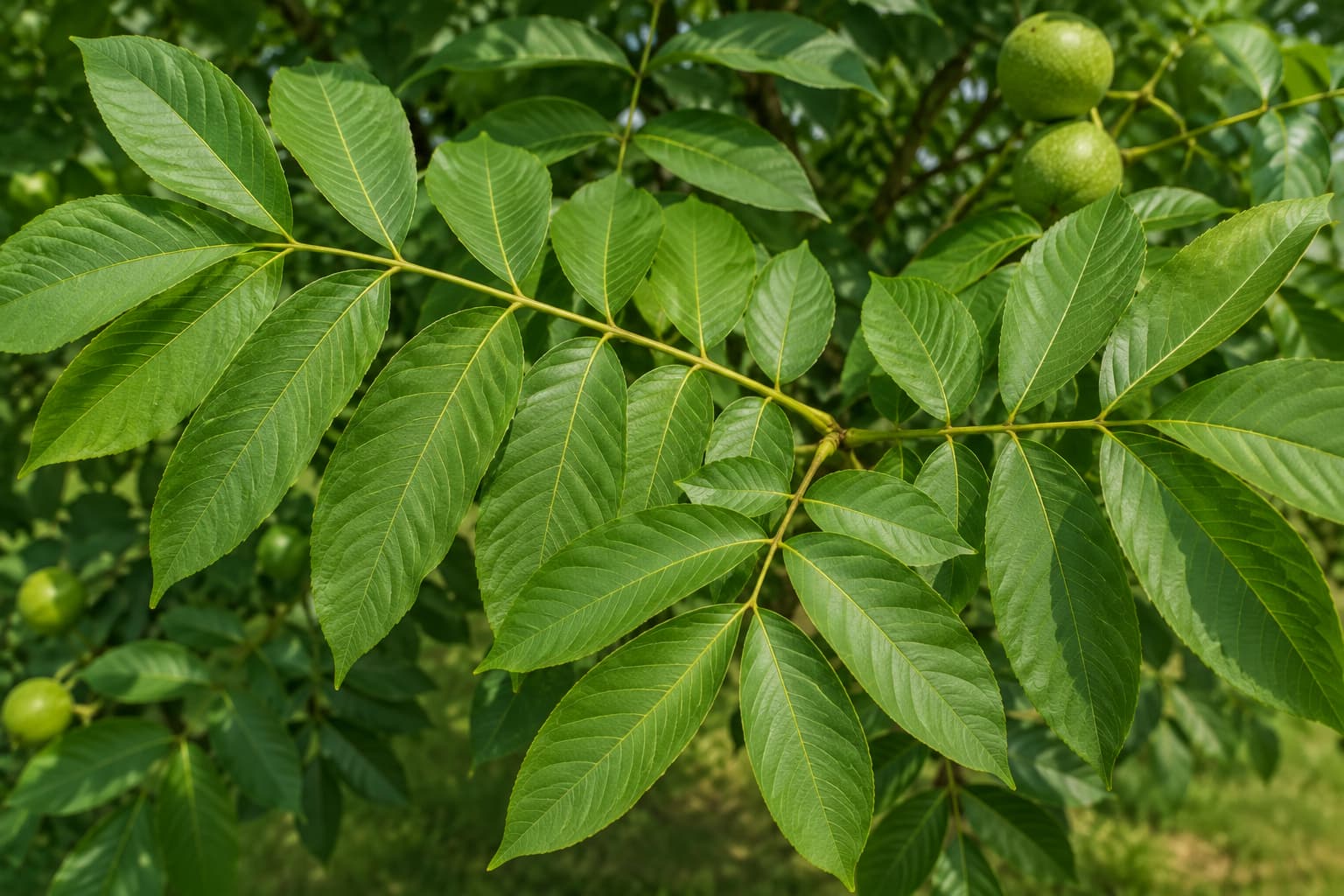
Walnut Tree Leaf Identification — 6 Key Features
Walnut tree leaf identification uses the following six features in combination. The aromatic test alone is highly reliable, but combining all features provides complete identification confidence for distinguishing between walnut species and from similar trees like hickory and ash.
The most important walnut tree leaf identification feature — walnut leaves are not simple single blades but compound leaves divided into multiple leaflets along a central stalk. This compound structure immediately distinguishes walnut from most trees. Count the leaflets: 15-23 = likely Black Walnut; 7-9 = likely English Walnut; 11-17 = Butternut.
Crush any walnut tree leaf between your fingers — Black Walnut produces an immediate strong, spicy, citrus-like aromatic scent from volatile oils. This aromatic quality is unique among common trees and is the single most reliable instant walnut identification test. English walnut leaves have a milder but still distinctive walnut scent.
In Black Walnut, the terminal (end) leaflet is often smaller than the adjacent lateral leaflets — or completely absent. This is opposite to hickory, where the terminal leaflet is the largest. In English Walnut, the terminal leaflet is well-developed and similar in size to the largest lateral leaflets. This distinction helps separate walnut from hickory.
Walnut leaflet margins are finely to moderately serrated — small, uniform teeth around the leaflet edge. Black Walnut leaflets have more consistently toothed margins than English Walnut, which can have nearly entire (smooth) to slightly toothed margins. The serration is subtle compared to elm or birch.
Walnut leaves are alternate on the twig — one compound leaf per node, alternating sides. This distinguishes walnut from ash trees, which have opposite compound leaves (two per node directly across from each other). Combined with the aromatic smell, alternate arrangement immediately confirms walnut.
The main leaf stalk (rachis) of Black Walnut is often slightly hairy or glandular. Butternut (White Walnut) has distinctly sticky-hairy rachis and leaf stalks — a useful tactile identification feature. English Walnut rachis is smoother. Feeling the leaf stalk texture helps distinguish walnut species from each other.
Black Walnut Tree Leaves Identification
Black walnut tree leaves are the largest and most complex walnut leaves — a single compound leaf has 15-23 leaflets arranged along a central stalk that can reach 30-60cm in length. Black walnut tree leaves identification uses the large number of leaflets (more than any other North American walnut) as the primary distinguishing feature from English Walnut (7-9 leaflets) and Butternut/White Walnut (11-17 leaflets).
Individual black walnut tree leaves (the entire compound leaf) turn yellow in autumn before dropping, often earlier than surrounding trees. The black walnut tree leaves images most commonly searched show the compound leaf with numerous long lance-shaped leaflets, distinctive in their large number and slightly yellow-green color in summer. The leaflets are oval to lance-shaped, 6-12cm long, with finely serrated margins and prominent parallel veins. The undersides of black walnut leaflets are often slightly hairy, particularly along the veins.
A distinctive feature of black walnut tree leaves is that the terminal (end) leaflet is often notably smaller than the adjacent lateral leaflets — or completely absent. This is a reliable distinction from hickory trees, which also have large compound leaves but always have a terminal leaflet that is the largest in the leaf. Leaves walnut tree identification specifically focusing on this terminal leaflet size comparison with hickory prevents the most common misidentification of walnut. For more compound leaf identification, see our complete leaf identification guide.
English Walnut Tree Leaves — Identification Guide
English walnut tree leaves differ from black walnut tree leaves in several important ways. The most immediately obvious difference is leaflet count — English walnut tree leaves typically have only 5-9 leaflets (usually 7), compared to 15-23 in Black Walnut. This fewer-leaflet structure makes English Walnut leaves look less complex and more open than Black Walnut leaves. The individual leaflets of English Walnut are also larger — up to 15cm long — giving the leaf a bold, open appearance despite having fewer leaflets.
English walnut tree leaves are less aromatic than Black Walnut when crushed — they have a mild walnut scent but not the strong spicy-citrus character of Black Walnut. The leaflet margins of English Walnut are often nearly smooth (entire) to only slightly toothed — compared to the more consistently serrated leaflets of Black Walnut. English walnut tree leaves are alternate on the twig, like all walnuts, and the terminal leaflet is well-developed — often the largest in the compound leaf, unlike Black Walnut where it is often reduced.
Walnut tree leaves pictures and images of walnut tree leaves in online searches most often show Black Walnut or English Walnut. The easiest way to distinguish them in photos is leaflet count: if you count more than 11 leaflets, it is almost certainly Black Walnut; if you count 7-9, it is almost certainly English Walnut.
Black Walnut Tree Identification — Beyond the Leaves
Black walnut tree identification uses leaves, bark, fruit (nuts), and a uniquely reliable diagnostic technique — the chambered pith test. Cut a walnut twig lengthwise and examine the center (pith) — unlike most trees where the pith is solid white or cream, walnut pith is distinctively chambered: divided into brown segments separated by partitions. This chambered brown pith is found in both Black Walnut and Butternut but NOT in hickory, ash, or other compound-leaved trees. It immediately confirms the identification as a walnut (Juglans) regardless of season.
The Black Walnut tree produces one of the most valuable hardwoods in North America — the deeply figured dark brown heartwood commands premium prices for furniture, gunstocks, cabinets, and decorative woodworking. A single large Black Walnut tree can be worth thousands of dollars for its timber, making "walnut rustling" (theft of walnut trees from private land) a surprisingly common crime in the Midwest. The combination of valuable timber and desirable nuts makes Black Walnut one of the most economically important native trees of eastern North America.
Black walnut tree seeds (black walnut tree seeds / walnuts) are produced in round green husks that turn black when the nut is ripe, falling from the tree in October. The husks contain juglone and other compounds that stain hands, clothing, and paved surfaces dark brown-black — a stain that is extremely difficult to remove. Collecting Black Walnuts for eating requires wearing gloves to avoid this staining. The hard-shelled nuts inside the husks contain rich, strongly flavored walnut kernels that are excellent in baked goods and cooking.
Walnut Tree Bark Identification
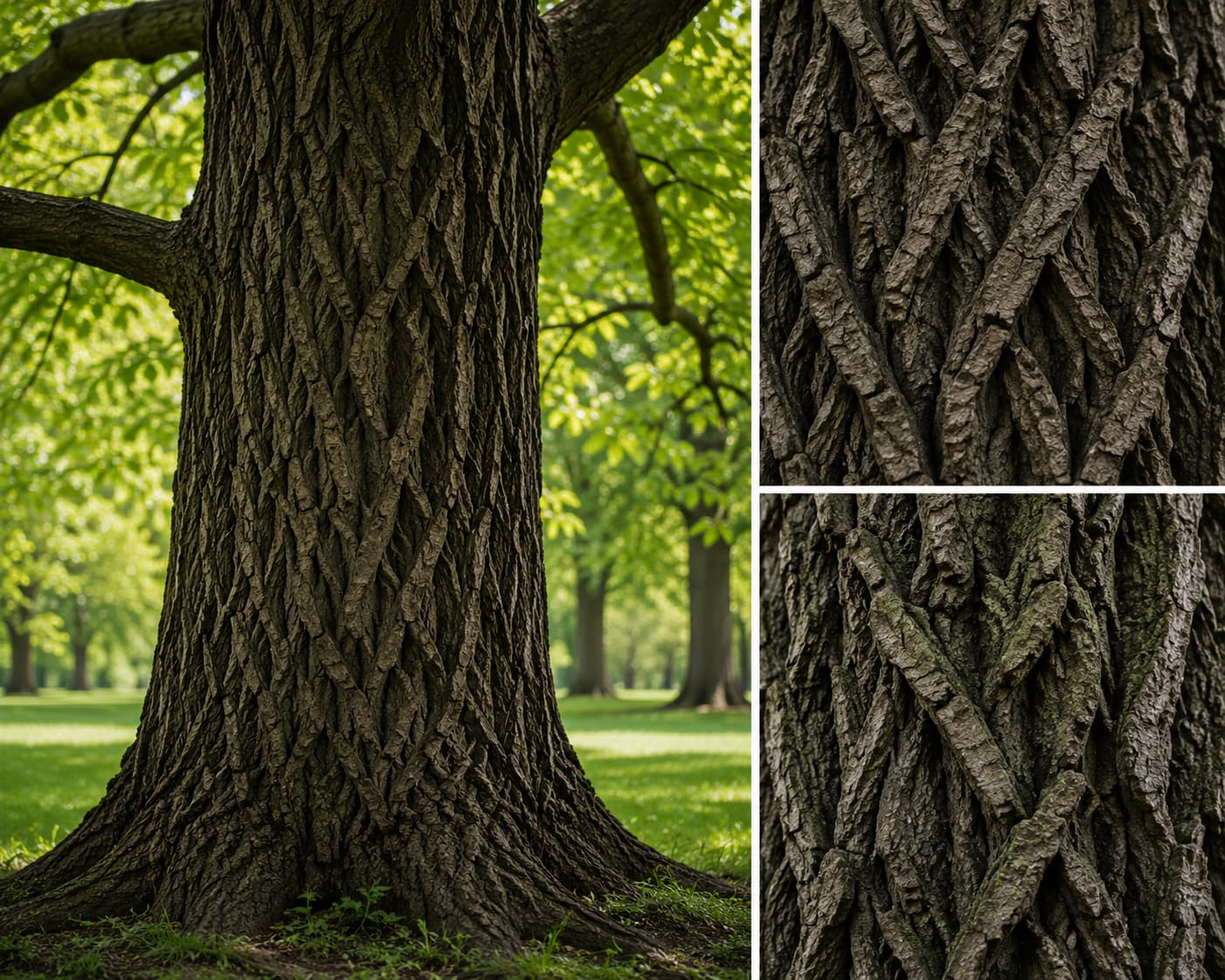
Walnut tree bark identification provides year-round identification clues — bark is present and visible even when leaves have fallen. Black walnut tree bark identification relies on the distinctive color and furrow pattern: mature Black Walnut bark is very dark gray-brown with deep, interlocking diamond or Y-shaped furrows creating a rough, strongly textured surface. This dark, deeply diamond-patterned bark is quite distinctive — darker and more deeply furrowed than most other hardwoods of similar size. The black walnut tree bark identification from this dark diamond pattern is reliable on trees more than 20-25 years old when the pattern has fully developed.
Young Black Walnut bark (on trees less than 10-15 years old) is smoother and lighter gray-brown, developing the characteristic deep furrows only with age. Walnut tree bark identification for young trees is less reliable from bark alone — use the compound leaves and aromatic smell in season, or the chambered pith test year-round.
English Walnut bark is lighter gray than Black Walnut and develops somewhat less deeply furrowed bark with broader, more irregular ridges. Butternut (White Walnut) bark is distinctly lighter gray with flat-topped grayish ridges and shallower furrows — notably lighter than Black Walnut. The color difference between Black Walnut (very dark) and Butternut (light gray) is often the fastest bark-based distinction between these two species. For a comprehensive bark identification guide, see our complete bark identification guide.
Types of Walnut Trees — Complete Species Profiles
The walnut genus (Juglans) contains approximately 21 species worldwide. The following profiles cover the most important types of walnut trees with complete identification details for each.
#1 Black Walnut
Juglans nigra · Eastern North America (native)
#2 English Walnut / Persian Walnut
Juglans regia · Central Asia to SE Europe (widely cultivated worldwide)
#3 White Walnut / Butternut
Juglans cinerea · Eastern North America (native, increasingly rare)
#4 California Black Walnut
Juglans californica · Southern California (native)
#5 Arizona Walnut
Juglans major · SW United States and Mexico
White Walnut Tree Identification (Butternut)
White walnut tree identification (Juglans cinerea, Butternut) requires careful attention to distinguish from Black Walnut since the two species share many features. The key differences for white walnut tree identification: Butternut nuts are oval to oblong (elongated, 4-7cm long) rather than round like Black Walnut nuts — the elongated nut shape is the most reliable single distinction. Butternut bark is lighter gray with flat-topped ridges, notably lighter than the very dark bark of Black Walnut. Butternut leaflet stalks and young twigs are distinctly sticky-hairy to the touch — running a finger along the main leaf stalk of Butternut feels rough and slightly sticky, while Black Walnut stalks are smoother.
White Walnut is now seriously threatened by Butternut Canker disease — a fungal pathogen (Ophiognomonia clavigignenti-juglandacearum) that has killed a significant percentage of wild Butternut trees across eastern North America since the 1990s. Infected trees show dead and dying branches, sunken orange-brown cankers on the bark, and eventual crown dieback and death. Conservation efforts are focused on finding disease-resistant individuals. If you find a healthy mature Butternut in the wild, it may be a disease-resistant individual worth reporting to conservation authorities.
Are Walnuts Tree Nuts? — Classification and Allergy Information
Are walnuts tree nuts? Yes — walnuts are definitively tree nuts, produced by trees of the genus Juglans. In botanical classification, walnuts are technically drupes — a type of fleshy fruit with three layers: an outer fleshy husk (exocarp), a hard shell (endocarp), and the edible seed inside (the walnut kernel or meat). This is the same fruit structure as peaches, cherries, and olives, but in walnuts the outer fleshy layer is the dry green-to-black husk rather than a juicy edible flesh.
In common food terminology and allergy classification, "tree nuts" refers to edible seeds produced by trees, as distinguished from ground nuts (peanuts, which grow underground as legumes). Walnut is one of the "Big Eight" (now Big Nine) major food allergens in the United States, alongside milk, eggs, fish, shellfish, wheat, soy, peanuts, and sesame. Walnut allergy can cause reactions ranging from mild oral allergy syndrome (itching and swelling) to severe anaphylaxis in sensitive individuals. Cross-reactivity between walnut and other tree nuts (particularly pecan, which is a close relative also in the family Juglandaceae) is common.
Walnut Tree Identification by Leaf vs Hickory
The most common walnut misidentification is with hickory trees — both have large pinnately compound leaves that appear similar at first glance. Walnut tree identification by leaf compared to hickory focuses on three reliable distinctions: the aromatic crush test (walnut = strong spicy citrus scent; hickory = little or no scent when leaves are crushed), terminal leaflet size (walnut = terminal leaflet often small or absent; hickory = terminal leaflet always the largest in the compound leaf), and leaflet count (Black Walnut = 15-23 leaflets; most hickories = 5-9 leaflets).
Additionally, the chambered pith test (cutting a twig to reveal the center) works year-round: walnut pith is brown and chambered (segmented); hickory pith is solid white. This distinction works even in winter when no leaves are present and is the most reliable year-round test when bark and nut features are ambiguous. For detailed hickory identification, see our Hickory Tree Identification Guide.
Frequently Asked Questions — Walnut Tree Identification
How do I identify a walnut tree by its leaves?
Walnut tree leaves are large pinnately compound leaves with 7-23 leaflets. The most reliable test: crush a leaflet and smell — Black Walnut produces a strong spicy-citrus scent, immediately confirming identification. Count leaflets: 15-23 = Black Walnut; 7-9 = English Walnut; 11-17 = Butternut. Terminal leaflet is small or absent in Black Walnut (opposite to hickory where it is the largest).
What is Black Walnut tree?
Black Walnut (Juglans nigra) is a large native eastern NA hardwood (18-30m) with 15-23 leaflet compound leaves that smell strongly of spicy citrus when crushed, deeply diamond-furrowed very dark bark, round green husked nuts that stain brown-black, and roots that produce juglone toxin inhibiting surrounding plants.
What is English Walnut tree?
English Walnut (Juglans regia) produces the commercial walnuts sold worldwide. Has fewer leaflets (5-9) than Black Walnut, lighter bark, thinner-shelled nuts with larger milder-flavored kernels. Less aromatic leaves than Black Walnut. Native to Central Asia, widely cultivated globally for nut production.
What does walnut tree bark look like?
Black Walnut bark is very dark gray-brown with deep diamond/Y-shaped intersecting furrows — one of the most distinctively patterned dark barks of any hardwood. Butternut bark is much lighter gray with flat-topped ridges. English Walnut bark is intermediate — lighter than Black Walnut with shallower furrows.
What is White Walnut tree (Butternut)?
Butternut (Juglans cinerea) has 11-17 leaflets, distinctive oval/oblong nuts (not round like Black Walnut), lighter gray bark, and sticky-hairy leaf stalks. Critically threatened by Butternut Canker fungal disease which has killed most wild Butternuts across eastern North America.
Are walnuts tree nuts?
Yes — walnuts are tree nuts (technically drupes). Botanically: fleshy outer husk + hard shell + edible seed inside. Walnut is a major food allergen. Cross-reactive with pecan (family Juglandaceae). Classified as tree nuts in food allergy terminology, distinct from peanuts (legumes that grow underground).
How do I identify a Black Walnut sapling?
Black walnut tree sapling identification: large compound leaves with 15-23 leaflets even on young plants, strong spicy aromatic smell when leaves crushed, and chambered brown pith in twigs (cut twig lengthwise — brown segmented center unique to walnuts). Young bark is smooth gray-brown before developing diamond furrows.
Identify Your Walnut Tree Instantly
Found a walnut tree and want to confirm the species? Upload a photo to our free AI Tree Identifier for instant identification from walnut tree leaves images, bark, nuts, or full-tree photos. Related guides: Hickory Tree Identification Guide, How to Identify Trees by Leaves, Tree ID by Bark, Trees With Heart Shaped Leaves, and Fast Growing Trees.
Species tools: Oak Tree Identifier, Maple Tree Identifier, Elm Tree Identifier, Birch Tree Identifier, Pine Tree Identifier, Fruit Tree Identifier.