What Is Alder? — Alder Definition and Meaning
Alder definition: alder is the common name for trees and shrubs of the genus Alnus in the family Betulaceae — the birch family. The alder genus (Alnus) comprises approximately 35 species distributed across temperate and boreal regions of the Northern Hemisphere, with a few species in the Andes of South America.
The alder name meaning comes from Old English alor or aler, derived from Proto-Germanic aliso — a word historically associated with wet, marshy ground. This etymological connection perfectly reflects the alder's ecology: alders grow almost exclusively in wet or waterlogged conditions where most other trees cannot survive. Define alder simply as "a water-loving birch-family tree with distinctive woody cone-like seed structures." Alder def in botanical terms: a nitrogen-fixing riparian tree of the genus Alnus, Betulaceae. Use our AI Tree Identifier to identify any alder species from a photo instantly.
What Does an Alder Tree Look Like? — Complete Visual Description
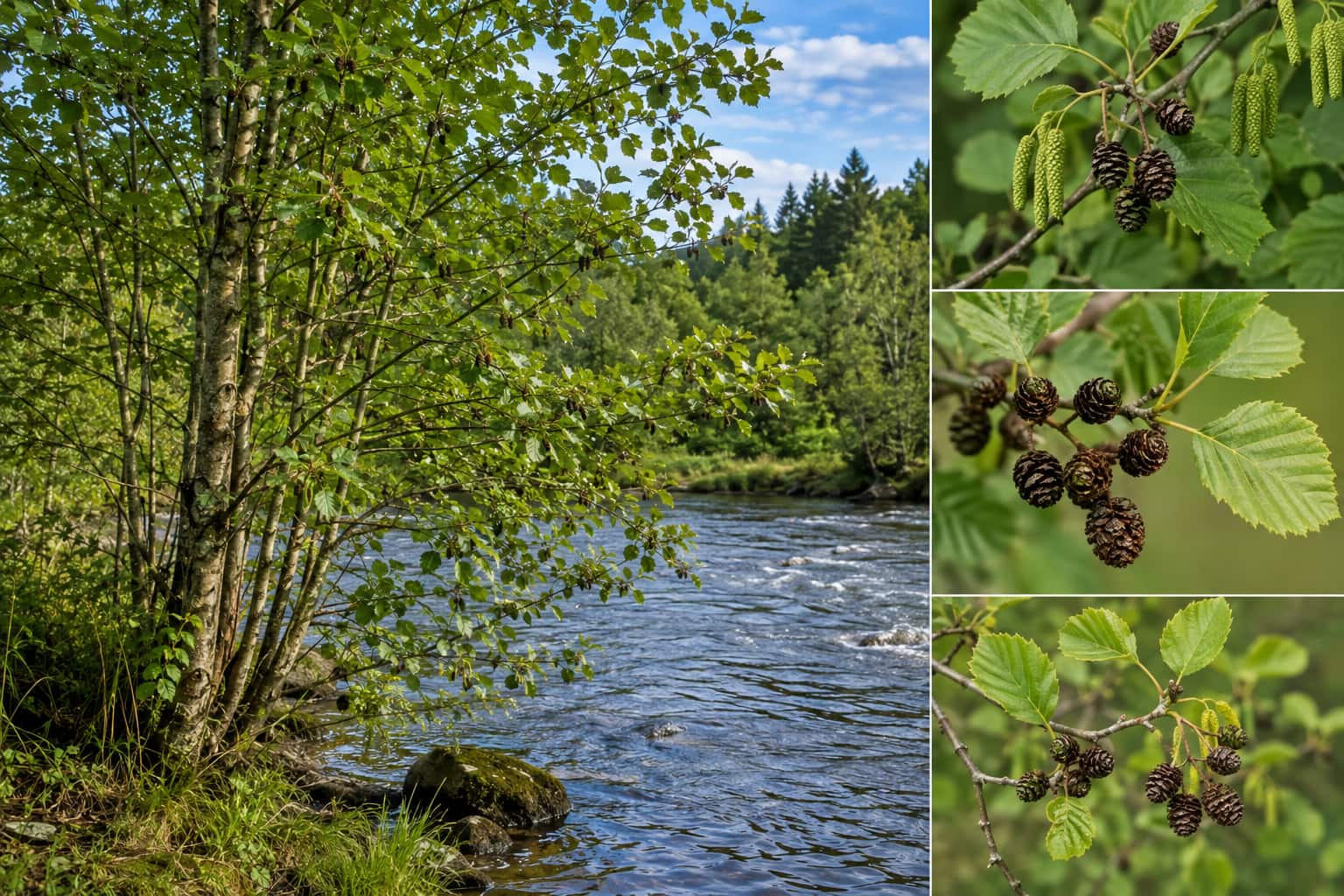
What does an alder tree look like? Alders are medium-sized deciduous trees typically reaching 15-25 meters tall, though some species (Red Alder, Common Alder) can reach 30 meters. The overall form is irregular — an open, somewhat uneven crown with branches that often lean over water. Alders frequently grow in dense stands along riverbanks, creating a characteristic riparian woodland with intertwined crowns and roots anchoring the bank.
The most immediately distinctive feature of what an alder tree looks like is the presence of small woody cone-like structures on the branches. These are properly called strobiles — structures derived from female catkins that harden into persistent woody "cones" after releasing their seeds. Unlike true pine cones, alder strobiles are small (1-3.5cm depending on species), dark brown to black, and remain on the tree throughout the year, even after the seeds have been released. Old strobiles from the previous year remain on the branches alongside new developing female catkins and male catkins — meaning alder branches carry structures from multiple reproductive seasons simultaneously.
The bark of young alder trees is smooth and gray-green to gray-brown, developing furrows and darker coloration with age. Common Alder (Alnus glutinosa) develops dark gray-brown fissured bark on mature trees — giving rise to the common name "Black Alder" for this species. Red Alder has distinctively pale, often white bark that becomes covered in grayish-white lichens, making it appear almost as pale as a birch from a distance.
Alder Tree Identification — 6 Key Features
Alder tree identification is straightforward once you know the key features. The following six features cover everything needed for confident alder identification in any season.
Woody Cone-like Strobiles
CriticalThe single most distinctive alder feature — small woody "cones" (actually catkin-derived strobiles) that persist on branches year-round, even through winter. These dark brown woody structures, 1-3cm long, are found on no other common broadleaf tree and immediately identify alders in any season.
Rounded Leaf with Notched Tip
HighCommon Alder leaves are distinctly rounded to oval with a flat or slightly notched tip — unlike most trees where the tip is pointed. This rounded notched tip distinguishes Common Alder from Birch (pointed tip) and most other trees.
Stalked Winter Buds
HighAlder buds in winter are raised on a short stalk (stalked buds) rather than sitting directly on the twig. This stalked bud arrangement is unusual and immediately distinguishes alders from birches and most other trees in winter.
Waterside Habitat
HighAlders grow almost exclusively near water — rivers, streams, lakes, and marshes. Finding a medium-sized deciduous tree growing at the water's edge with woody cones is almost certainly an alder.
Nitrogen-Fixing Root Nodules
EcologicalAll alders have root nodules containing nitrogen-fixing Frankia bacteria, enriching soil with 50-100kg nitrogen per hectare annually. This ecological function makes alder critical for riparian and forest ecosystem health.
Male Catkins in Late Winter
MediumAlders produce long (4-10cm) yellow-brown male catkins that develop in late winter, often visible as tight dark buds through winter before expanding dramatically in late February-March — one of the earliest signs of spring in temperate forests.
Alder Tree Leaves — Identification Guide
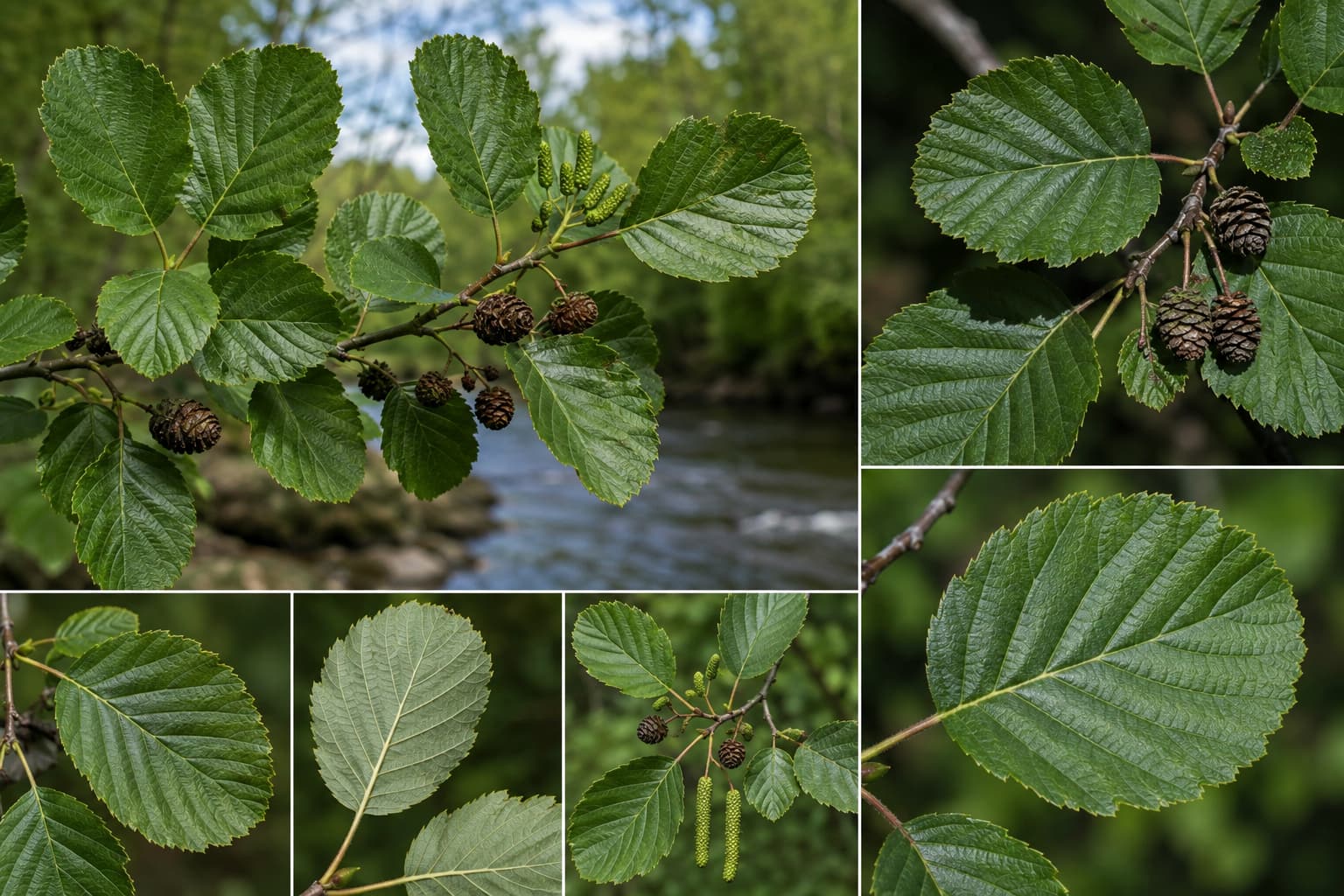
Alder tree leaves are alternate on the twig, simple, and vary in shape between species. The most distinctive leaf feature of Common Alder (Alnus glutinosa) is the rounded or flat-tipped leaf apex — unlike most trees where the leaf tip is pointed, Common Alder leaves have a flat or slightly notched (emarginate) tip, giving them a rounded appearance at the end. This rounded tip immediately distinguishes Common Alder from the similar-looking Hazel, Birch, and other trees whose leaves all taper to a point.
Alder tree leaves are typically oval to broadly oval, 4-10cm long, with a doubly serrated or toothed margin — alternating large and small teeth around the leaf edge. The leaf surface is dark green above and paler beneath, with tufts of hairs in the vein junctions on the underside in many species. Common Alder leaves have a distinctly sticky, slightly glutinous feel when young — reflected in the species name glutinosa (sticky).
Red Alder (Alnus rubra) has the largest leaves of common North American alders — 7-15cm, oval to oblong, with a pointed tip and a distinctive feature: the leaf margin rolls slightly downward (revolute margin), giving the leaves a subtle curl at the edge. White Alder (Alnus rhombifolia) leaves are oval to slightly diamond-shaped (rhombic) — reflected in the species name rhombifolia.
Common Alder (Alnus glutinosa) — The European Alder
Common Alder (Alnus glutinosa), also called Black Alder or els tree in some regional traditions, is the most widespread and familiar alder of Europe and western Asia. It is found beside virtually every river, stream, lake, and wetland from Ireland to western Siberia, and has been naturalized in parts of North America. Alnus glutinosa (betulaceae alnus glutinosa) is the defining riparian tree of the European lowlands.
The name "Black Alder" for Alnus glutinosa refers to the dark gray-brown bark of mature trees and the black-brown color of the woody strobiles — not to any blackness of the leaves or wood. Young Common Alder bark is smooth and gray-green, developing darker furrows and ridges only with age. The inner bark and wood of freshly cut Common Alder turn a distinctive orange-red color when exposed to air — a striking transformation caused by oxidation of tannins and other compounds. This color change was once used to produce an orange-red dye and is a useful field identification feature when cutting wood.
Common Alder (alder glutinosa) plays a fundamental role in European riverine ecosystems. Its roots are colonized by nitrogen-fixing Frankia bacteria, enriching the soil and water with nutrients. Its leaf litter is particularly nutritious — decomposing faster than most tree leaves and providing food for aquatic invertebrates. Fallen alder trunks in rivers create important fish habitat. The dense root systems prevent bank erosion. Few trees have such wide-ranging positive effects on their ecosystems as the Common Alder.
Red Alder Tree — The Pacific Northwest Pioneer
Red Alder (Alnus rubra) is the most important and abundant broadleaf deciduous tree of the Pacific Coast of North America, ranging from southeastern Alaska south to San Luis Obispo County in California. It is the largest alder in North America, reaching 25-35 meters in favorable conditions, and is found wherever there is disturbance, moisture, and access to light — forest edges, streamsides, roadsides, logged areas, and landslide scars.
The name "Red Alder" refers to the red or orange-red color of the inner bark when scratched — similar to Common Alder's color change when cut. Red Alder bark itself is pale gray to white on the outside, often covered in patches of white or gray lichen, making it appear light-colored from a distance. Red alder tree bark is one of the most reliable identification features — the combination of pale outer bark and red inner bark (visible when scratched) is unmistakable.
Red alder seeds (alder tree seeds) are tiny winged nutlets contained within the persistent woody strobiles. When mature, the strobiles open and the seeds are released, dispersed by wind and water. Red alder seeds can float considerable distances in streams and rivers, colonizing new ground downstream. The species regenerates prolifically from seed following disturbance, making it one of the most successful pioneer trees of the Pacific Northwest.
How has the red alder tree influenced succession? Red Alder is a classic example of a facilitation pioneer in ecological succession. When forest is cleared or disturbed, Red Alder rapidly colonizes the open ground, growing fast and fixing 50-100+ kg of nitrogen per hectare per year through its root nodules. This nitrogen enrichment dramatically improves soil fertility, creating conditions favorable for the establishment of conifers like Douglas Fir and Sitka Spruce. As these shade-tolerant conifers grow up, they eventually overtop and shade out the alder (which cannot regenerate in its own shade), replacing the alder-dominated early successional forest with a conifer-dominated climax forest. Red Alder thus actively facilitates the development of the forest communities that ultimately replace it — a fascinating example of ecological self-sacrifice.
White Alder (Alnus rhombifolia) — The Western Stream Alder
White Alder (Alnus rhombifolia) — sometimes called white alder alnus rhombifolia in full — is the common streamside alder of California and the interior western United States, growing along streams, in canyon bottoms, and beside rivers from British Columbia south through California and east to Idaho and Montana. It is the ecological equivalent of Common Alder in western North America, forming dense stands along waterways where it provides shade, bank stabilization, and nutrient enrichment.
Alnus rhombifolia is named for its leaves — rhombifolia means "diamond-leaved," referring to the slightly rhombic (diamond) outline of the leaves, broader in the middle and tapering both toward the base and the tip. White Alder leaves have finely doubly serrated margins and are lighter green than Red Alder, with a glossy surface when mature. The bark of White Alder is gray to light gray — paler than Common Alder but less dramatically pale than Red Alder.
Alder Tree Species — Complete Profiles
The following profiles cover the six most important alder species and types with full identification details for each.
#1 Common Alder / Black Alder
Alnus glutinosa · Europe to western Siberia
#2 Red Alder
Alnus rubra · Pacific Coast North America (Alaska to California)
#3 White Alder
Alnus rhombifolia · Western United States
#4 Speckled Alder
Alnus incana · North America and Europe
#5 Green Alder
Alnus viridis · Mountains of Europe and North America
#6 Italian Alder
Alnus cordata · Italy and Corsica (widely planted)
Alder Bark — Identification and Properties
Alder tree bark varies significantly between species but several consistent features help identify alders from their bark. The most useful feature is that fresh-cut or scratched alder bark reveals orange-red inner bark — a distinctive color change caused by oxidation of compounds in the bark. This orange-red color on the inner surface of scratched bark is present in Common Alder, Red Alder, and most other species, providing a useful confirmation feature.
Alder bark was historically used as a source of tannin for leather curing, and as a traditional medicine in European folk herbalism. The high tannin content of alder bark produces astringent properties used for treating inflammation, skin conditions, and diarrhea. Alder bark was also used to produce black, red, and brown dyes for wool and cloth — the different colors achieved depending on the mordant used with the bark extract. For more bark identification information, see our complete bark identification guide.
Alder Wood — Uses and Properties
What is alder wood? Alder wood is a fine-grained, pinkish-brown hardwood that is surprisingly strong and workable despite coming from a relatively fast-growing tree. Fresh alder wood is white, turning the characteristic orange-pink to light brown within hours of cutting. Alder wood is lightweight, straight-grained, and works excellently with both hand and machine tools, taking stain and paint very well.
Historically, alder wood had a remarkable property: while it rots quickly when alternately wet and dry, it is exceptionally durable when kept permanently underwater or permanently in waterlogged conditions. This unusual durability in wet anaerobic conditions made alder wood the preferred choice for building foundations in medieval European cities built over marshes — Venice's foundations are largely built on alder piles, as are many buildings in Amsterdam, Dublin, and other waterside European cities.
Modern uses for alder wood include furniture (especially painted furniture), kitchen cabinets, turned objects, charcoal production, and smoking wood — alder is the traditional smoking wood for Pacific Northwest salmon and other fish, producing mild, slightly sweet smoke. Red Alder wood in particular is considered one of the finest smoking woods available. Alder charcoal was historically used in gunpowder manufacture. Today, alder is the preferred wood for electric guitar bodies in many designs — Fender Stratocasters and Telecasters have traditionally used alder for its balanced tonal properties.
Alder Shrub and Alder Bush — Smaller Alder Forms
Not all alders are large trees — several species and some individuals of tree-forming species grow as multi-stemmed shrubs or alder bushes rather than single-trunked trees. Green Alder (Alnus viridis) typically grows as an alder shrub in mountain and subalpine environments, rarely exceeding 3-4 meters. Speckled Alder (Alnus incana) in North America often forms dense alder shrub thickets along streams in the boreal zone. Common Alder may grow as an alder shrub or small multi-stemmed tree in exposed or nutrient-poor conditions.
Alder plant identification for shrub forms follows the same principles as for tree forms — the persistent woody strobiles, stalked buds, and habitat association with water all apply regardless of growth form. The alder plant is often one of the few woody plants capable of colonizing and stabilizing very wet, waterlogged ground where no other shrub can grow.
Alder Tree Seeds — Identification and Dispersal
Alder tree seeds are tiny winged nutlets, 2-3mm long, released from the woody strobiles (cone-like structures) when they open at maturity. Each strobile contains numerous small seeds — typically 40-100 per strobile — with papery wings on either side that aid wind dispersal. In species growing beside water (most alders), seeds also float effectively, dispersing downstream along watercourses.
Alder tree seeds germinate readily on moist bare mineral soil — the conditions created by bank erosion, flooding, or human disturbance beside water. The seeds require light to germinate and cannot establish in dense shade. This light requirement means alders typically colonize open disturbed ground rather than understory of existing forest. Red alder seeds are among the most successful colonizing seeds in the Pacific Northwest, establishing dense stands on cleared or burned land within 1-3 years of disturbance.
Frequently Asked Questions — Alder Trees
What does an alder tree look like?
An alder tree looks like a medium-sized deciduous tree (15-30m) with an irregular open crown, typically growing beside water. The most distinctive feature is small woody cone-like strobiles (1-3cm) persisting on branches year-round. Bark is smooth gray-green when young, darkening with age. Leaves are oval with a rounded or flat tip in Common Alder.
Where do alder trees grow?
Alder trees grow almost exclusively near water — rivers, streams, lakeshores, marshes, and wet woodland. Common Alder grows throughout Europe beside rivers and streams. Red Alder grows along the Pacific Coast from Alaska to California. White Alder (Alnus rhombifolia) grows beside streams in the western United States.
What is an alder tree?
An alder tree is any member of the genus Alnus, family Betulaceae (birch family). About 35 species exist worldwide. They are famous for growing in waterlogged conditions, fixing atmospheric nitrogen through root bacteria, and producing distinctive persistent woody cone-like seed structures (strobiles).
What is alder — alder definition and meaning?
Alder definition: a deciduous water-loving tree or shrub of the genus Alnus, Betulaceae family. Alder name meaning derives from Old English "alor" associated with wet marshy ground. Alder genus (Alnus) contains 35 species. Key features: woody cone-like strobiles, nitrogen-fixing roots, waterside habitat.
How has the red alder tree influenced succession?
Red Alder colonizes disturbed Pacific Northwest forest, fixes 50-100kg nitrogen/hectare/year through root bacteria, enriching soil for subsequent species. As Douglas Fir and other conifers establish and grow taller, they shade out the light-demanding alder. Red Alder thus facilitates development of the conifer climax forest that ultimately replaces it — a key ecological succession facilitator.
What does alder tree look like in winter?
In winter, alder trees are identified by small dark brown woody strobiles (cone-like) remaining on bare branches, stalked purple-red buds (raised on a short stalk unlike most trees), and yellow-brown male catkins developing in late winter. Habitat beside water is also a strong winter identification clue.
Is alder in the birch family (Betulaceae)?
Yes — alder (Alnus) belongs to Betulaceae, the birch family, alongside birch (Betula), hornbeam (Carpinus), hazel (Corylus). Alders differ from birches by their persistent woody strobiles, wet habitat preference, and nitrogen-fixing root nodules.
Identify Your Alder Tree Instantly
Found an alder tree and want to confirm the exact species? Upload a photo to our free AI Tree Identifier for instant identification. The AI identifies all major alder species — Common Alder, Red Alder, White Alder, Speckled Alder, Italian Alder, and Green Alder — from leaf, bark, strobiles, or full-tree photos.
For leaf identification, our Leaf Identifier analyzes the distinctive rounded tip and toothed margin features. Related guides: Mulberry Tree Guide, Poplar Tree Guide, Beech Tree Guide, Willow Tree Guide, Tree ID by Bark, and Winter Tree ID.
Species tools: Oak Tree Identifier, Maple Tree Identifier, Elm Tree Identifier, Birch Tree Identifier, Pine Tree Identifier, Fruit Tree Identifier.