Beech Tree Definition — What Is a Beech Tree?
The beech tree definition: a beech tree is any member of the genus Fagus in the family Fagaceae, comprising approximately 10-13 species of large deciduous trees native to temperate regions of Europe, Asia, and North America. The name "beech" comes from the Old English bēce, which derives from the same Proto-Germanic root as the word "book" — beech wood tablets were among the earliest writing surfaces in northern Europe, giving us an etymological connection between beech trees and literacy.
Beech trees are defined by several consistent features across all species: exceptionally smooth gray bark, oval leaves with prominent parallel veins, small triangular nuts (beechnuts) enclosed in spiky husks, and a tendency to hold dead leaves through winter (marcescence) especially on younger trees and lower branches. Use our AI Tree Identifier to identify any beech species from a photo in seconds.
American Beech (Fagus grandifolia) — Complete Guide
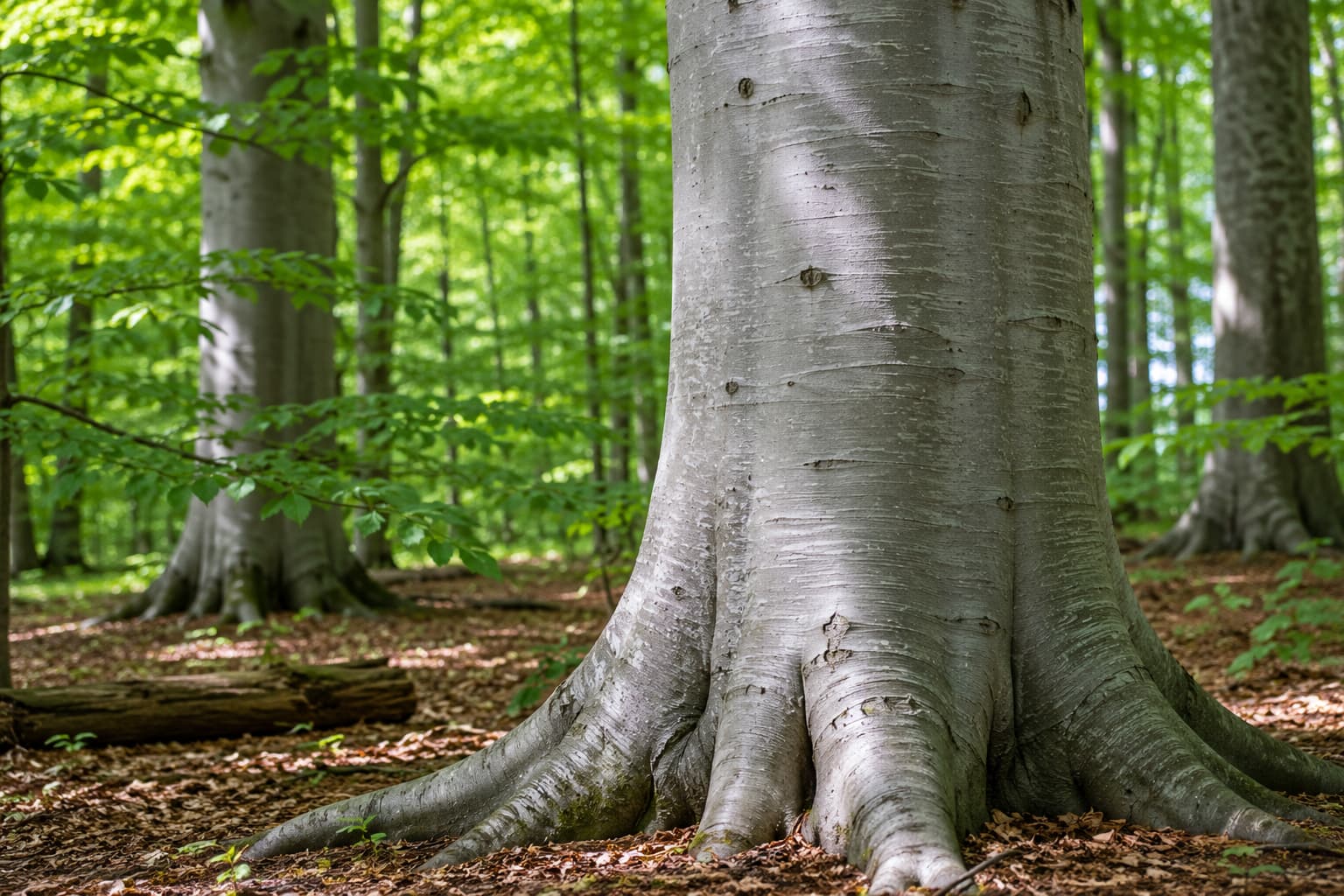
American Beech (Fagus grandifolia) is the only beech species native to North America and one of the most important and recognizable trees of eastern North American forests. The species name grandifolia means "large-leaved" — reflecting that American Beech leaves are noticeably larger than those of its European cousin.
American Beech is found throughout eastern North America, from Nova Scotia and New Brunswick south to northern Florida, and west to Wisconsin, Illinois, and eastern Texas. It is particularly abundant in the mixed hardwood forests of the Appalachian Mountains, the Great Lakes region, and New England, where it forms a dominant component of the Beech-Maple forest type — one of the most important forest communities in eastern North America.
The most distinctive feature of Fagus grandifolia is its bark — exceptionally smooth and silvery-gray, unlike any other common large tree in North America. While oaks, maples, and hickories develop rough furrowed bark as they age, American Beech retains its smooth elephant-skin-like bark throughout its life, even on trees hundreds of years old. This smooth bark has made beech trees a favorite target for carving initials — unfortunately, these carvings persist for decades and can introduce diseases into the tree.
American Beech Leaves
American Beech leaves are oval to oblong, 6-12cm long, with a distinctive pointed tip and a coarsely toothed margin — each tooth corresponds to one of the prominent parallel veins that run from the midrib to the leaf edge. These parallel veins (9-14 pairs) give beech leaves their characteristic ribbed appearance and are one of the most reliable leaf identification features. The leaf surface is dark green and slightly glossy above, paler below, with silky hairs when young that mostly disappear by summer.
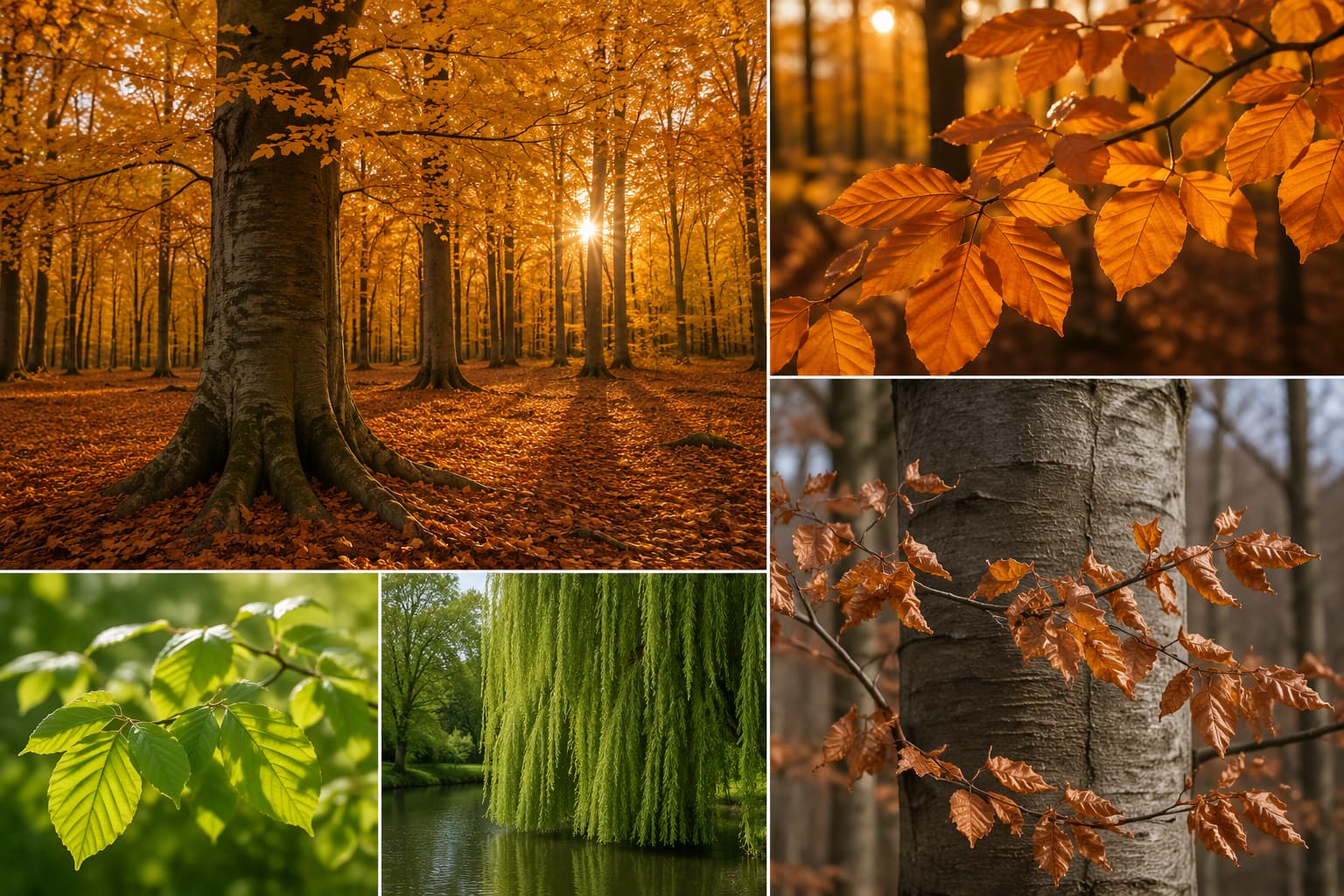
One of the most distinctive seasonal features of American Beech is marcescence — the retention of dead leaves through winter. While most deciduous trees drop their leaves cleanly in autumn, beech trees (especially younger trees and the lower branches of older trees) hold their dead copper-bronze leaves through the winter, creating a warm russet glow in otherwise bare winter forests. The functional reason for marcescence in beech is not fully understood, but it may deter deer browsing by making nutritious buds less accessible beneath a layer of dry leaves.
European Beech (Fagus sylvatica) — The Forest King of Europe
European Beech (Fagus sylvatica) is the most important broadleaf forest tree in central and western Europe, forming vast cathedral-like forests across Britain, France, Germany, Poland, and into eastern Europe. The name sylvatica means "of the forests" — an appropriate name for a tree that defines the forest landscape of an entire continent.
European Beech closely resembles American Beech but has several distinguishing features: slightly smaller leaves (4-9cm) with a wavy rather than toothed margin, fewer pairs of veins (5-9 compared to 9-14 in American Beech), and slightly smaller beechnuts. European Beech forms a denser canopy than American Beech, casting such deep shade that virtually no understory plants can survive beneath mature beech forest — the forest floor beneath a closed beech canopy is carpeted only with beech leaf litter, moss, and shade-tolerant ferns.
European Beech forests — called Buchenwälder in German — are among the most celebrated natural landscapes in Europe. The Hainich National Park in Germany, the Bialowieza Forest in Poland/Belarus, and the beech forests of the Carpathians are UNESCO World Heritage Sites recognized for their ecological and scenic value. In Britain, the beech woods of the Chiltern Hills and the New Forest are iconic landscapes.
Tricolor Beech Tree — The Most Ornamental Beech
Tricolor beech (Fagus sylvatica 'Roseomarginata', also sold as 'Purpurea Tricolor') is one of the most spectacular ornamental trees available to gardeners — a cultivar of European Beech with leaves that display three distinct colors simultaneously throughout the growing season. The leaf center is deep purple-maroon, transitioning to an irregular zone of pink to rose-red, with white to very pale pink at the outer margin — creating a stunning multi-colored effect unlike any other common ornamental tree.
The tricolor beech grows more slowly than the standard European Beech, typically reaching 6-10 meters in a landscape setting, making it more suitable for smaller gardens than the full-sized species. For best color development, tricolor beech should be planted in partial shade — in full sun, the pink coloration tends to fade to whitish and the purple center lightens considerably. Morning sun with afternoon shade provides ideal conditions. The tree performs best in moist, well-drained, slightly acidic soils — the same conditions preferred by all beech species.
Beech Tree Identification — Key Features
Beech trees are among the easiest large trees to identify due to their unique combination of smooth bark, distinctive leaves, and winter leaf retention. Follow these key identification features:
Bark — smooth, silvery-gray, and remaining smooth even on very large, old trees. This is the single most reliable beech identification feature at any time of year. No other common large tree maintains smooth bark throughout its life — all other hardwoods eventually develop rough, furrowed, or scaly bark.
Leaves — oval with a pointed tip, prominent parallel veins (like the ribs of a boat), and toothed (American Beech) or wavy (European Beech) margins. The parallel vein pattern is immediately recognizable. Leaves are alternate on the twig.
Winter leaf retention — dead copper-bronze leaves persisting on the tree through winter, especially on younger trees and lower branches. In a winter forest, a tree with dead leaves still attached is almost certainly a beech or young oak.
Beech buds — in winter, beech buds are very distinctive: long (1-2cm), sharp, cigar-shaped, and copper to reddish-brown in color. These pointed torpedo-like buds are unmistakable and make winter beech identification simple. For more winter identification tips, see our complete winter tree identification guide.
Beech Nuts — Wildlife Food and Human History
Beech nuts (beechnuts, beech mast) are the small triangular nuts produced by beech trees, enclosed in spiky four-valved husks called cupules. Each cupule typically opens to reveal 1-3 triangular nuts about 1-1.5cm long. The nuts have a thin brown shell enclosing a small kernel with a mild, slightly sweet flavor.
Beech mast is one of the most important wildlife foods in both North American and European forests. In mast years — bumper crop years occurring every 2-5 years — the forest floor beneath beech trees is carpeted with nuts, providing abundant food for deer, bears, wild boar, squirrels, chipmunks, wood ducks, blue jays, grouse, and many other species. Black bears in particular depend heavily on beech mast in autumn to build up fat reserves for hibernation, and the timing and abundance of mast crops directly affects bear population dynamics.
Beech nuts have also been important to human populations historically. In Europe, beechnuts were widely eaten during famines and hard times, roasted and ground as a coffee substitute, and pressed to produce beechnut oil — a high-quality cooking and lamp oil. In North America, Indigenous peoples used beechnuts as a food source. Today, beechnuts are occasionally gathered by foragers but are not commercially cultivated due to the low nut-to-shell ratio and the difficulty of harvest.
Beech Tree Disease — Beech Bark Disease and Beech Leaf Disease
Beech trees in North America currently face two major diseases that are causing significant population declines and raising conservation concerns for American Beech (Fagus grandifolia).
Beech Bark Disease (BBD) is caused by a combination of a non-native scale insect (Cryptococcus fagisuga) and fungal pathogens (Neonectria species). The scale insect creates tiny wounds in the smooth beech bark, allowing the fungi to enter and create cankers that girdle and kill the tree. Beech Bark Disease has killed millions of American Beech trees in eastern North America since its introduction from Europe in the late 1800s. Affected trees show white waxy deposits on the bark (from scale insect colonies), followed by rough corky patches of damaged bark, bleeding cankers, and eventual death. Some individual trees show resistance to BBD and are the focus of conservation efforts.
Beech Leaf Disease (BLD) is a newer and more alarming threat, first identified in Lake County, Ohio in 2012 and spreading rapidly throughout the eastern United States and Canada. It is caused by a foliar nematode (Litylenchus crenatae mccannii) and produces distinctive dark green banding between leaf veins — visible when infected leaves are held up to light. Severely infected trees show shriveled, leathery, reduced leaves and progressive crown thinning and dieback. Unlike Beech Bark Disease, BLD affects all size classes of beech, killing young seedlings and saplings as well as mature trees, threatening the regeneration of beech populations.
Beech Wood — Uses and Properties
Beech wood (beechwood) is one of the most important and versatile hardwoods in Europe and North America. It is a diffuse-porous hardwood with a fine, straight grain and uniform texture that works exceptionally well with both hand and machine tools. Beech wood is hard, dense, and strong, with excellent resistance to abrasion and shock.
The wood is pale pinkish-brown to cream-white, often with a slight reddish tinge. It stains and finishes well, accepting wood stains uniformly due to its fine even texture. Beech is not naturally durable outdoors, but responds very well to steam-bending — a quality that has made it historically important for chair making, where the steam-bent components of Windsor and other traditional chair designs have been produced from beech for centuries.
Chairs, tables, bed frames — beech is the classic European furniture wood, durable and takes stain well.
Beech hardwood flooring is prized for durability and attractive grain — common in European homes.
Wooden spoons, cutting boards, rolling pins, bowls — beech is the traditional kitchen utensil wood.
Hammer handles, chisel handles, woodworking tools — beech resists splitting and shock.
Beech wood produces mild, slightly sweet smoke used for smoking fish, meats, and cheeses — a European tradition.
High heat output, burns slowly and cleanly — beech is considered one of the best European firewoods.
Beech Tree Species — Complete Profiles
The following profiles cover the most important beech species and ornamental cultivars, with identification features for each.
#1 American Beech
Fagus grandifolia · Eastern North America
#2 European Beech
Fagus sylvatica · Europe (Britain to Caucasus)
#3 Copper Beech / Purple Beech
Fagus sylvatica f. purpurea · Garden cultivar — worldwide
#4 Tricolor Beech
Fagus sylvatica 'Roseomarginata' · Garden cultivar — worldwide
#5 Weeping Beech
Fagus sylvatica 'Pendula' · Garden cultivar — worldwide
#6 Oriental Beech
Fagus orientalis · SE Europe & SW Asia
Frequently Asked Questions — Beech Trees
What is a beech tree?
A beech tree is any member of the genus Fagus — large deciduous hardwood trees famous for their exceptionally smooth silvery-gray bark, oval leaves with prominent parallel veins, small triangular beechnuts, and copper leaf retention in winter. About 10-13 species exist worldwide.
What is American Beech (Fagus grandifolia)?
American Beech is the only beech native to North America, found throughout eastern North America. It is identified by its smooth silvery-gray bark (smoothest of any large NA tree), oval toothed leaves with 9-14 pairs of veins, and retention of dead copper-bronze leaves through winter.
What is European Beech (Fagus sylvatica)?
European Beech is the dominant forest tree of central and western Europe. Similar to American Beech but with smaller leaves (4-9cm), wavy rather than toothed margins, and fewer vein pairs. Forms dense cathedral-like forests across Europe.
What is beech tree disease?
American Beech faces two major diseases: Beech Bark Disease (caused by scale insects + fungal pathogens, killing millions of trees since the 1800s) and Beech Leaf Disease (caused by a foliar nematode, first identified in 2012 and spreading rapidly, affecting all age classes of beech).
What are beech nuts?
Beech nuts are small triangular nuts produced by beech trees, enclosed in spiky four-valved husks. They are a critical wildlife food for deer, bears, squirrels, and birds. Edible for humans when roasted, with a mild sweet flavor. Produced in heavy mast crops every 2-5 years.
What is tricolor beech tree?
Tricolor beech (Fagus sylvatica "Roseomarginata") is a stunning ornamental cultivar with leaves showing three colors simultaneously — dark purple center, pink-rose margin, and white outer edge. Best color in partial shade. Grows 6-10 meters tall.
What is beech wood used for?
Beech wood is used for furniture, flooring, tool handles, kitchen utensils (spoons, cutting boards), toys, plywood, and smoking wood. It is hard, straight-grained, and excellent for steam bending. One of the most important European hardwoods.
Identify Your Beech Tree Instantly
Found a beech tree and want to confirm the species? Upload a photo to our free AI Tree Identifier for instant species identification. The AI identifies American Beech, European Beech, Copper Beech, Tricolor Beech, and all other beech species and cultivars from leaf, bark, or full-tree photos.
For leaf-specific identification, our Leaf Identifier analyzes the distinctive parallel vein pattern and leaf margin features that distinguish beech leaves. Related guides: Willow Tree Guide, Trees with Heart Shaped Leaves, Oak Tree Identification Guide, Maple Tree Guide, Tree ID by Bark, and Winter Tree ID Guide.
Species tools: Oak Tree Identifier, Maple Tree Identifier, Elm Tree Identifier, Fruit Tree Identifier, Birch Tree Identifier, Pine Tree Identifier.