What Tree Has White Bark? — Quick Identification Guide
Several common trees have white bark — but they are easily distinguished from each other by whether the bark peels, the exact shade of white, and associated features. The three most commonly encountered white-barked trees in North America are Paper Birch (brilliant white, peeling), Quaking Aspen (creamy white, smooth, not peeling), and American Sycamore (camouflage-patchwork white on upper trunk). In Europe, White Birch (Silver Birch) is the most common white-barked tree.
The fastest identification shortcut: Does the white bark peel in papery strips? If yes = almost certainly a birch. If no and the bark is smooth creamy-white with dark eye-like scars = Aspen. If the white is camouflage-patterned = Sycamore. If brilliant pure white smooth and shedding = Ghost Gum (warm climates). Use our AI Tree Identifier with a bark photo for instant species identification year-round.
Paper Birch (Betula papyrifera) — The Iconic White Bark Tree
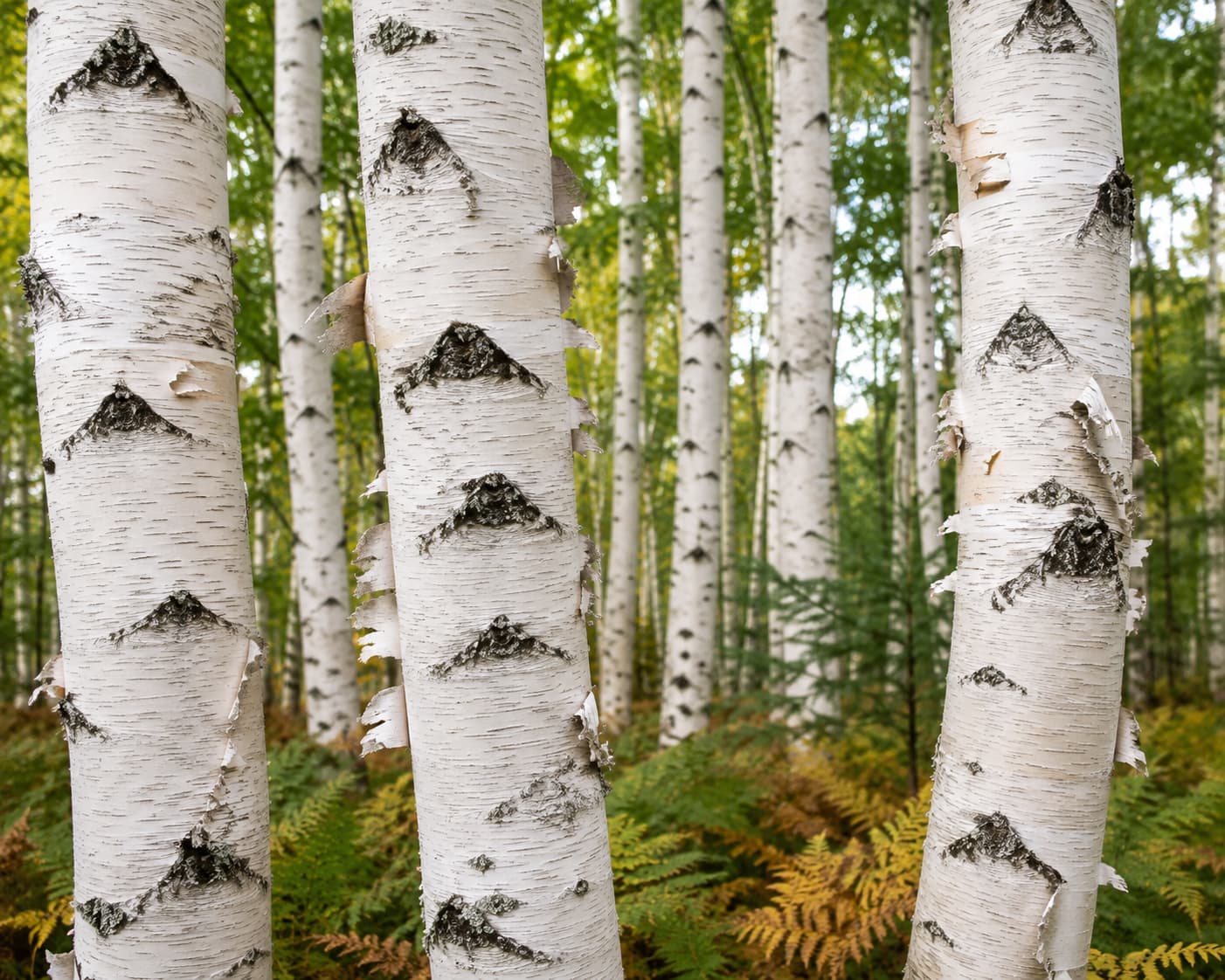
Paper Birch (Betula papyrifera) is the most iconic white-barked tree in North America — the tree that defines the image of the northern forest. The species name papyrifera means "paper-bearing" in Latin, perfectly describing the bark's most distinctive feature: it peels in thin horizontal papery strips, like layers of white paper. This papery peeling birch bark is immediately recognizable and unlike any other common tree. Paper birch is also called White Birch (Betula white birch), Paperbark Birch, or Canoe Birch in reference to its most famous traditional use.
The bark of Paper Birch is brilliant chalky-white with distinctive black diamond-shaped lenticels (breathing pores) arranged horizontally across the bark surface. These black marks give the white bark a spotted, elegant appearance. On young Paper Birch trees (saplings and small trees), the bark may be tan or orange-brown before developing the characteristic white color at 5-10 years of age. The bark becomes most brilliantly white at full maturity and remains white for the tree's entire life. White birch sapling bark is not yet white — this often confuses people trying to identify young trees.
Paper Birch leaves (white birch leaves / paper birch leaf) are triangular to oval, 5-10cm long, with a pointed tip and doubly serrated margin — alternating large and small teeth around the leaf edge. The leaves are alternate on the twig and turn a clear bright yellow in autumn before dropping. Paper birch leaves are distinctly different from the lobed maple or oak leaves they sometimes share forest space with — the simple triangular shape with doubly-toothed margins is consistent and reliable. White birch leaves are identical in structure to Paper Birch leaves since they are the same species.
White Birch vs Paper Birch — Are They the Same Tree?
The names "White Birch" and "Paper Birch" cause significant confusion because they are used differently in different contexts. In North America, "White Birch" is simply an alternate common name for Paper Birch (Betula papyrifera) — they are the same tree. The white birch tree, white birch bark, white birch leaf, and white birch sapling all refer to Betula papyrifera in North American usage.
However, "White Birch" is also used to refer to European White Birch (Betula pendula), also called Silver Birch — a similar but distinct species native to Europe and Asia. When comparing birch betula species, European White Birch differs from Paper Birch in having slightly smaller leaves, more pendulous (drooping) branches, and black marks at the base that extend further up the trunk. The two species are very similar in appearance and both have the characteristic white peeling bark. In North America, Betula papyrifera is the native species while Betula pendula is sometimes planted as an ornamental — check the range to determine which you have found. White paper birch trees for sale in North American nurseries are typically Betula papyrifera.
Quaking Aspen — White Bark Without Peeling
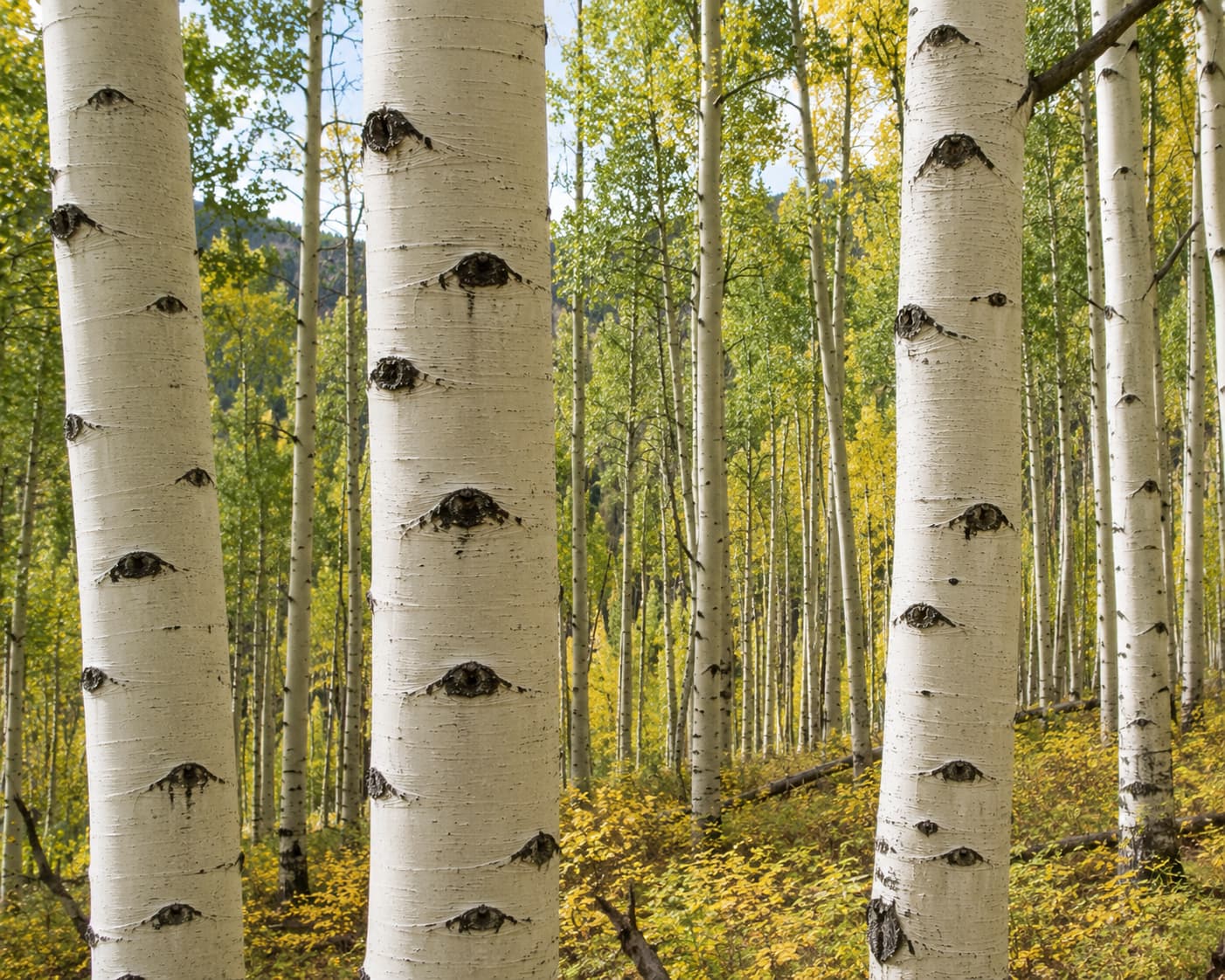
Quaking Aspen (Populus tremuloides) is the most widely distributed tree in North America and has distinctive creamy-white bark — but critically, aspen bark does NOT peel like birch. This is the most important distinction between aspen and birch for anyone identifying a white-barked tree. If the white bark is smooth and does not peel in strips, and the tree is in a group or stand, think Aspen first.
Aspen bark is creamy-white to greenish-white with distinctive dark, eye-shaped scars where old branches have fallen off. These oval dark scars are a reliable identification feature — combined with the smooth non-peeling white bark, they give Aspen a distinctive appearance unlike birch. The bark surface often has a powdery or chalky texture from a natural wax coating. Old Aspen trunks develop dark, rough furrows at the base — the white bark appears mainly on younger trees and the upper portions of old trees.
Aspen forms massive clonal groves — what appears to be a forest of individual trees is often a single genetic individual connected by underground root systems. The famous Pando grove in Utah, considered the largest living organism on Earth by mass, is a single Quaking Aspen clone covering 43 hectares with approximately 47,000 stems. In autumn, entire aspen groves turn brilliant golden-yellow simultaneously — since all trees in the clone are genetically identical, they respond to temperature and day length in perfect synchrony.
American Sycamore — Camouflage White Bark
American Sycamore (Platanus occidentalis) has one of the most distinctive barks of any North American tree — a camouflage-pattern patchwork of white, tan, and olive-green created by the outer bark flaking off in irregular patches to reveal bright white inner bark. The upper trunk and main branches of a large Sycamore are brilliantly white — visible from a great distance, especially in winter. This white upper trunk is a reliable long-distance identification feature for Sycamore.
Unlike birch and aspen, the white coloration of Sycamore bark is patchy and irregular — the camouflage pattern of multiple colors is unique and unmistakable. No other common North American tree has this distinctive multi-colored patchwork bark. The lower trunk of large Sycamores develops darker, scaly bark, while the upper trunk remains brilliantly white throughout the tree's life. A white sycamore tree (the upper trunk and branches) is one of the most striking sights in a winter floodplain landscape. For more bark identification guidance, see our complete bark identification guide.
White Barked Trees — Complete Species Profiles
The following profiles cover all major white bark trees and common peeling bark trees, with detailed identification features for each.
#1 Paper Birch / White Birch
Very EasyBetula papyrifera · Northern North America (Alaska to NE USA)
#2 European White Birch / Silver Birch
Very EasyBetula pendula · Europe and Asia
#3 Quaking Aspen
EasyPopulus tremuloides · Most widespread tree in North America
#4 American Sycamore
Very EasyPlatanus occidentalis · Eastern North America
#5 White Poplar
EasyPopulus alba · Europe, Asia (widely naturalized)
#6 Ghost Gum
Very Easy (in warm climates)Eucalyptus pauciflora · Australia (widely planted worldwide)
#7 River Birch
EasyBetula nigra · Eastern North America
#8 Yellow Birch
EasyBetula alleghaniensis · NE North America
#9 Himalayan Birch
Very EasyBetula utilis var. jacquemontii · Himalayas (widely planted in gardens)
#10 Paperbark Maple
EasyAcer griseum · China (widely planted)
Types of Tree Bark — Complete Guide
What is a tree bark? Tree bark is the outermost protective covering of a tree's trunk and branches, consisting of the inner bark (phloem) which transports sugars, and the outer bark (cork) which provides physical protection. Bark on trees varies enormously between species in color, texture, and pattern — making bark on a tree one of the most reliable year-round identification features. Understanding the types of bark helps identify trees in all seasons, especially in winter when leaves are absent.
Bark remains smooth and unbroken — no furrows, ridges, or peeling. Most common on young trees of all species and on mature trees of species like Beech.
Bark peels away in strips, plates, or patches revealing different-colored bark beneath. Most ornamental bark type.
Bark develops deep furrows and ridges with age. Most common mature bark type on large hardwoods.
Bark breaks into irregular scales or plates that are loose at the edges. Common on conifers and many mature hardwoods.
Bark develops irregular corky protrusions or wart-like growths. Hackberry bark is the most distinctive warty-barked common tree.
Bark is stringy and fibrous, pulling away in long strands. Most common on conifers, especially redwoods and cedars.
Trees With Peeling Bark — Identification Guide
Trees with peeling bark are among the most ornamental in the landscape — the combination of interesting texture, revealing color beneath, and year-round visual interest makes peeling bark trees highly sought after by gardeners. Peeling bark tree identification uses the color of both the outer peeling bark and the inner bark revealed when it peels.
White peeling bark — Paper Birch (Betula papyrifera) and Himalayan Birch (Betula utilis jacquemontii) are the classic white peeling bark trees. The bark peels in horizontal strips revealing slightly darker or pinkish inner bark. This type of peeling is also called exfoliating bark.
Salmon-pink to cinnamon peeling bark — River Birch (Betula nigra) peels in curling salmon-pink to cinnamon-brown strips — striking in winter against dark water or soil. This is the most common peeling bark birch in warm-climate gardens where Paper Birch does not thrive.
Camouflage patchwork peeling — Sycamore (Platanus occidentalis) peels in large irregular plates revealing white inner bark, creating the distinctive camouflage pattern that makes Sycamore bark unmistakable.
Cinnamon-red peeling — Paperbark Maple (Acer griseum) peels in thin curling cinnamon-red strips — one of the most ornamental barks of any small tree, spectacular year-round.
Shaggy gray strips — Shagbark Hickory (Carya ovata) peels in long gray strips curling outward at top and bottom — the most dramatically shaggy bark of any North American tree. For full details see our Hickory Tree Identification Guide.
Trees With Black Bark and Dark Bark
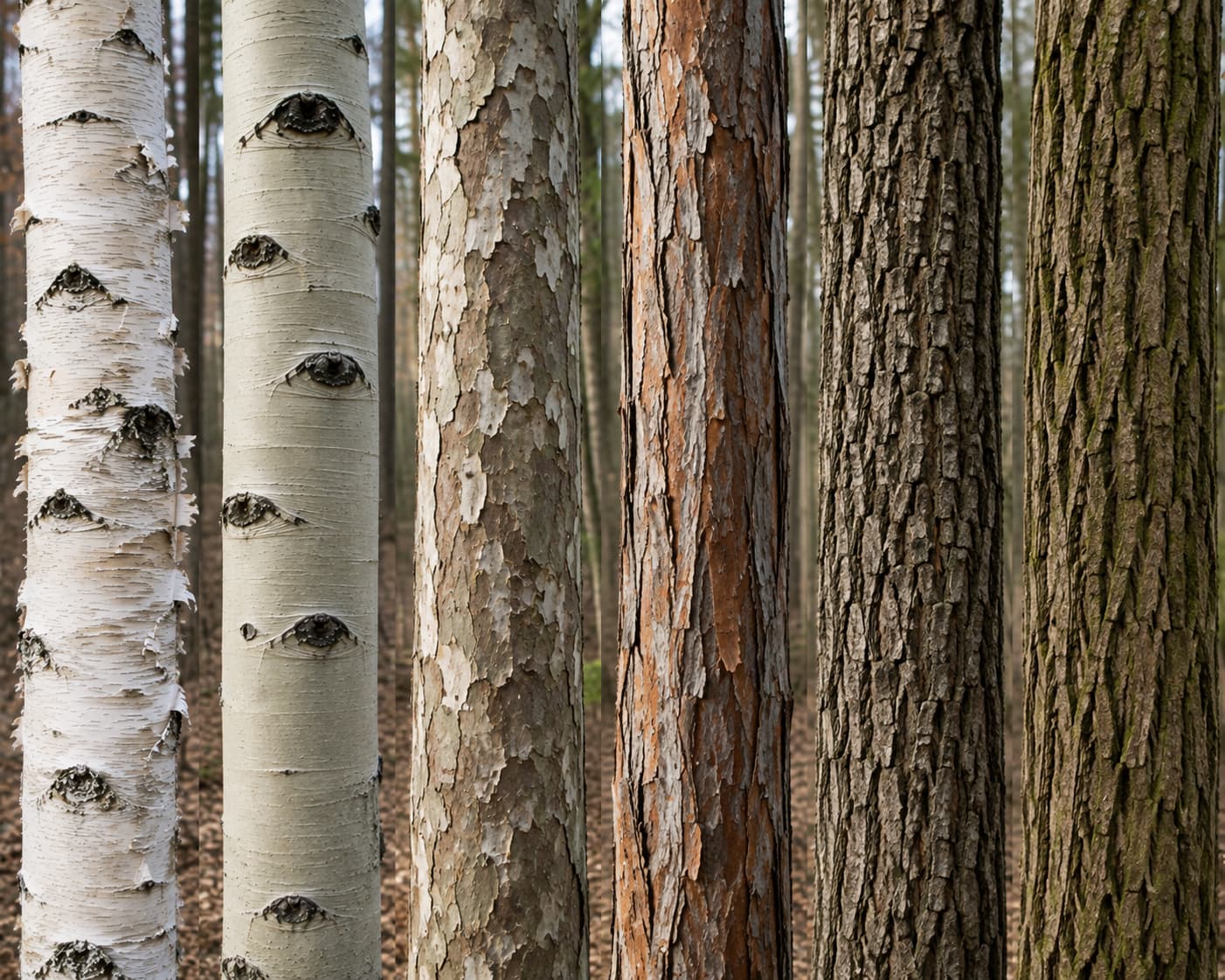
While this guide focuses on white bark trees, many readers searching for white bark trees are also curious about trees with black bark and dark barked trees for contrast planting. Trees with black bark include Black Locust (Robinia pseudoacacia) — very dark gray to almost black deeply furrowed rope-twist bark, Black Cherry (Prunus serotina) — distinctive dark "burnt cornflake" scaly bark, and Black Walnut (Juglans nigra) — dark gray-brown deeply furrowed bark with diamond-shaped ridges. Black barked trees and black bark tree species provide dramatic contrast when planted alongside white-barked birches and aspens in landscape design.
Trees with red bark include Pacific Madrone (Arbutus menziesii) — smooth peeling red to orange-red bark, and Scots Pine (Pinus sylvestris) — orange-red flaking bark on the upper trunk. A tree with green bark includes young Striped Maple (Acer pensylvanicum) — distinctive green bark with white vertical stripes — and young Palo Verde trees in the desert Southwest. A tree with red bark may also refer to Redwood trees whose fibrous bark has a warm reddish-brown color.
Paper Birch Bark — Cultural and Historical Uses
Paper birch bark (Betula papyrifera bark) has been one of the most important natural materials in North American Indigenous cultures for thousands of years. The bark is waterproof, flexible, lightweight, and naturally antiseptic — properties that made it ideal for a remarkable range of uses. Birch bark canoes were the primary watercraft of the Great Lakes and northeastern woodland peoples — lightweight enough to portage over land between waterways, yet durable enough for extended journeys.
Beyond canoes, paper birch bark was used for containers (baskets, pots, and storage vessels), shelters (wigwam coverings), writing material (sheets of bark were inscribed with symbols), torches (the oils in birch bark make it highly flammable even when wet), and various medicinal purposes. The white birch sapling was particularly valuable — young trees provided bark that was more flexible and easier to work than older trees. Many traditional crafts using birch bark continue to be practiced today.
A caution about harvesting: removing bark from living birch trees damages or kills them — the dark marks left by bark removal persist for the tree's lifetime and can introduce disease. Birch bark for craft purposes should be harvested from fallen trees or dead standing trees only.
Smooth Bark Trees — What Tree Has Smooth Bark?
Trees with smooth bark include American Beech (Fagus grandifolia) — the smoothest bark of any large North American tree, remaining remarkably smooth even on very old trees with thick trunks. A tree with smooth bark also includes young trees of most species — virtually all trees have smooth bark when young before it develops furrows and ridges with age. Other trees with smooth bark at maturity include Magnolia (smooth gray), Hornbeam (smooth muscular-looking gray), Serviceberry (smooth gray-brown), and young Sugar Maple (smooth gray-brown).
A tree with a smooth bark that is white or light-colored is most likely Beech (smooth gray), Aspen (smooth creamy-white), or young Paper Birch (smooth then peeling white). The distinction between smooth white bark that peels (birch) and smooth white bark that does not peel (aspen, beech) is the most important diagnostic feature for identifying white-barked smooth bark trees.
Frequently Asked Questions — Trees With White Bark
What tree has white bark?
The most common white bark trees are Paper Birch (brilliant white peeling), Quaking Aspen (smooth creamy-white, not peeling), American Sycamore (camouflage patchwork white), White Poplar (white to gray-white), and Himalayan Birch (whitest birch). Ghost Gum (warm climates) has the purest white bark of any tree.
What is Paper Birch (Betula papyrifera)?
Paper Birch is the iconic white-barked tree of North American forests. Brilliant chalky-white bark peels in horizontal papery strips with black diamond-shaped lenticels. "Papyrifera" = paper-bearing. Native to northern North America. Most ornamental white bark of any native NA tree.
What is the difference between Paper Birch and White Birch?
In North America, "White Birch" is an alternate name for Paper Birch (Betula papyrifera) — they are the same tree. European White Birch (Betula pendula) is a separate species with slightly smaller leaves, more drooping branches, and black bark marks extending higher up the trunk.
What trees have peeling bark?
Trees with peeling bark include Paper Birch (white peeling strips), River Birch (salmon-pink to cinnamon curling strips), Sycamore (camouflage patchwork), Shagbark Hickory (long gray strips), Yellow Birch (golden-bronze strips), and Paperbark Maple (cinnamon-red thin strips — most ornamental peeling bark).
What is tree bark and what is it used for?
Tree bark is the outermost protective layer of a tree — inner bark (phloem) transports sugars, outer bark (cork) provides protection. Bark protects against damage, drought, insects, and disease. Used by humans for cork, medicines (aspirin from willow), tannins, and traditional crafts. Birch bark was used for canoes and containers.
What is the difference between River Birch and Paper Birch?
Paper Birch bark is white and peels in horizontal strips. River Birch bark is salmon-pink to cinnamon-brown — NOT white. River Birch is much more heat tolerant, growing throughout eastern US. Paper Birch is a northern tree preferring cool climates. River Birch vs Paper Birch: different colors, different climates.
What trees have smooth bark?
Trees with smooth bark include American Beech (smoothest large tree bark), Quaking Aspen, young Magnolia, Hornbeam, Serviceberry, and young trees of most species. A smooth white bark tree is most likely Beech (gray), Aspen (creamy-white), or young birch (tan before turning white).
Identify Your White Bark Tree Instantly
Found a white-barked tree and want to confirm the species? Upload a bark photo to our free AI Tree Identifier for instant identification. The AI identifies all white bark trees — Paper Birch, Aspen, Sycamore, White Poplar, Himalayan Birch, Ghost Gum, and more — from bark, leaf, or full-tree photos.
Related guides: Tree Identification by Bark, Winter Tree ID Guide, Hickory Tree Guide, Beech Tree Guide, Fast Growing Trees, and Maple Tree Guide.
Species tools: Birch Tree Identifier, Oak Tree Identifier, Maple Tree Identifier, Pine Tree Identifier, Elm Tree Identifier.