Why Trees Produce White Flowers
White is one of the most common flower colors in trees — and for good reason. White flowers reflect the maximum amount of light, making them visible to pollinators in low-light conditions (early morning, dusk, and overcast days), and they are easily spotted by a wide range of pollinators including bees, flies, beetles, moths, and butterflies that are attracted to bright contrasting colors against green foliage. Many trees with white flowers also produce strong fragrances — Southern Magnolia, Black Locust, and Linden are among the most intensely fragrant trees in the world — amplifying their attractiveness to pollinators.
Spring is the peak season for white flowering trees in temperate regions — the cool, wet conditions of spring are ideal for flower production, and blooming before or with leaf emergence maximizes flower visibility to pollinators. The sequence of spring flowering trees creates a parade of bloom from earliest (Serviceberry in March) through latest (Catalpa in June-July), with white flowering trees appearing in every month of the blooming season. Use our AI Tree Identifier to identify any flowering tree from a photo instantly.
How to Identify Trees With White Flowers
Identifying a white flowering tree uses the flower structure, bloom timing, and associated tree features. The most important flower features to observe are: number of petals (5 petals = cherry family including cherry, peach, plum, apple, pear; many petals = magnolia; 4 bracts = dogwood; pea-shaped = locust, redbud), flower arrangement (single flowers, clusters, or upright/drooping sprays), flower size (tiny vs. large), and bloom timing relative to leaf emergence (before leaves = most spring flowering trees; with leaves = some species; after leaves = summer bloomers like Catalpa and Magnolia).
The relationship between flowers and leaves is particularly useful: trees that flower before leaves emerge (called precocious flowering) include most cherries, plums, redbud, magnolias, star magnolia, and serviceberry — the bare branches covered in flowers are unmistakable. Trees that flower with emerging leaves include many crabapples and dogwood. Summer-flowering trees like Catalpa, Linden, and Southern Magnolia flower well after leaves are fully developed. For a full guide to flower-based identification, upload a photo to our Leaf Identifier or Tree Identifier.
White Cherry Blossom — The Most Iconic Flower Tree
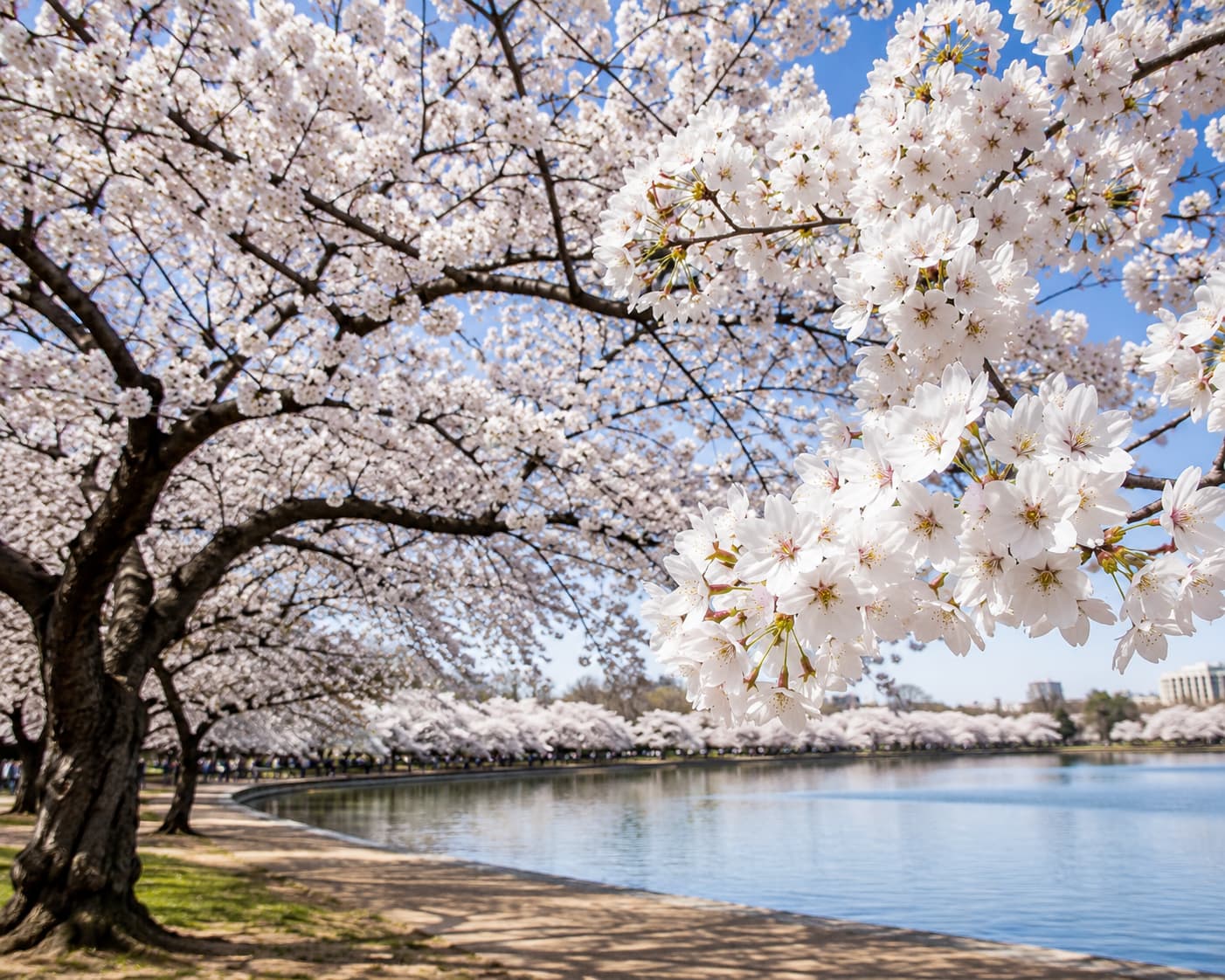
White cherry blossom is perhaps the most celebrated flower of any tree in the world — associated with spring, beauty, and the Japanese concept of mono no aware (the bittersweet awareness of impermanence). The Japanese cherry blossom tradition (hanami — flower viewing) has spread worldwide, and white flowering cherry trees now grace parks and streets across Europe, North America, and Australia.
The most famous white cherry blossom trees in the Western world are the Yoshino Cherry (Prunus × yedoensis) lining the Tidal Basin in Washington DC. These trees were a gift from Japan in 1912 and now number over 3,750, producing one of the world's most spectacular floral displays each spring. Yoshino Cherry produces pale white to very light pink flowers — often described as "white cherry blossom" even though they have a faint pink tinge. White flowering cherry at peak bloom is a breathtaking sight, with entire trees covered in flowers before a single leaf has opened.
The Great White Cherry (Prunus 'Tai Haku') is considered by many cherry blossom experts to be the most beautiful of all white flowering cherry trees — it produces enormous pure white single flowers (5-6cm across, the largest of any single-flowered cherry) that open against emerging bronze-red young leaves, creating a spectacular color contrast. 'Tai Haku' was lost to cultivation in Japan before a single specimen was rediscovered in an English garden in the early 20th century and reintroduced to Japan — a remarkable horticultural story.
Flowering Dogwood — America's Favorite White Flower Tree
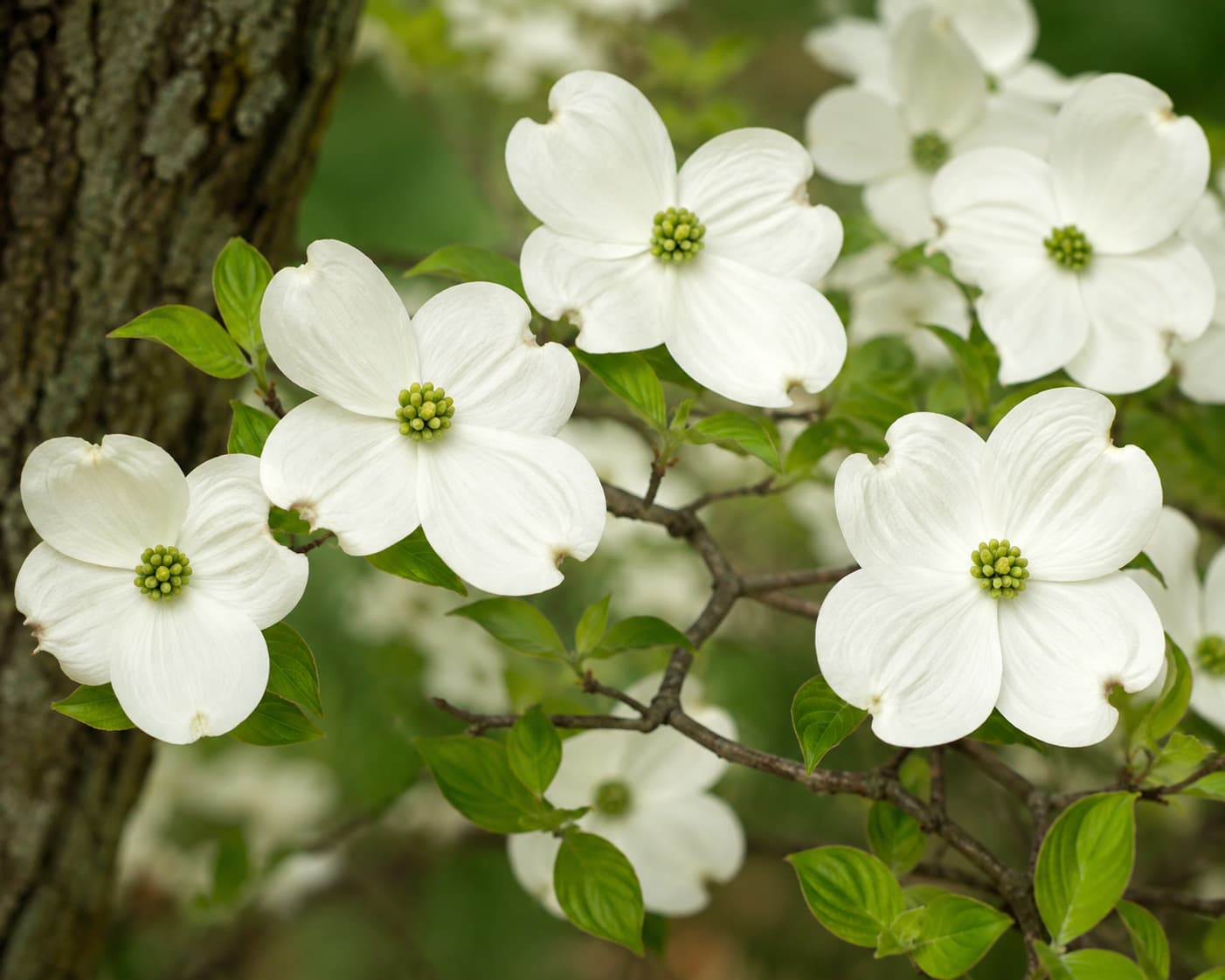
Flowering Dogwood (Cornus florida) is arguably the most beloved native flowering tree of eastern North America, producing spectacular white "flowers" (actually white bracts — modified leaves surrounding small central flowers) in April-May just as the forest canopy begins to emerge. The horizontal branching habit of Dogwood, combined with the white bracts opening in horizontal layers, creates a distinctive tiered flowering display unlike any other tree.
An important botanical clarification: the large white "petals" of Dogwood are not actually petals — they are bracts, modified leaf-like structures. The true flowers are small and inconspicuous, clustered at the center of the four bracts. Each bract typically has a distinctive notch at the tip — a reliable identification feature. The bracts start as tight green buds through winter, opening in spring to reveal the white display. Pink Dogwood (Cornus florida f. rubra) is a cultivar with pink rather than white bracts.
Flowering Dogwood provides four-season ornamental interest: white flowers in spring, attractive horizontal foliage and deep green leaves in summer, brilliant scarlet-red fall color (one of the most vivid of any tree), and persistent red berry clusters in winter that provide important food for migratory birds. This four-season value makes it one of the most recommended native ornamental trees for eastern North American gardens. For more about dogwood identification, see our bark identification guide.
Southern Magnolia — The Tree With the Biggest White Flowers
Southern Magnolia (Magnolia grandiflora) produces the largest white flowers of any commonly grown tree in the temperate world — blooms up to 30cm (12 inches) across, with 6-12 thick pure white petals arranged in a cup-like form. These enormous flowers have an intensely sweet fragrance combining lemon, vanilla, and cream — one of the most complex and beautiful scents in the plant world. A single Southern Magnolia in full bloom can perfume an entire garden and attract visitors from far away.
Unlike most spring flowering trees, Southern Magnolia flowers in summer — May through August depending on location — producing its enormous white blooms among large, glossy evergreen leaves. The flowers are followed by cone-like fruits (3-5cm) that split open to reveal bright red seeds in autumn — providing a second season of ornamental interest. Southern Magnolia is evergreen, providing year-round structural presence in the landscape, and its large bold leaves make it a dramatic specimen tree for warm-climate gardens (zones 6-10).
Star Magnolia (Magnolia stellata) is the white-flowered magnolia for small gardens and cool climates — a small tree (4-6 meters) producing pure white multi-petaled star-shaped flowers (7-10cm) in March-April before leaves emerge. Star Magnolia blooms earlier than any other magnolia, often when snow may still be present, making it a spectacular early spring flowering tree. The combination of pure white star-shaped flowers on bare gray branches is one of the most beautiful sights of early spring.
Trees With White Flowers — Complete Species Profiles
The following profiles cover all major white flowering trees from early spring through summer, with identification features and key growing information for each.
#1 Flowering Dogwood
Cornus florida · Eastern North America (native)
#2 Yoshino Cherry
Prunus × yedoensis · Japan (widely planted worldwide)
#3 Serviceberry / Juneberry
Amelanchier species · North America (native)
#4 Southern Magnolia
Magnolia grandiflora · Southeastern USA
#5 Star Magnolia
Magnolia stellata · Japan (widely planted)
#6 Great White Cherry
Prunus 'Tai Haku' · Japan (widely planted)
#7 Bradford Pear
Pyrus calleryana "Bradford" · Widely planted in eastern/central USA
#8 Black Locust
Robinia pseudoacacia · Eastern North America (native, widely naturalized)
#9 Flowering Peach
Prunus persica (ornamental varieties) · China (widely planted worldwide)
#10 Redbud (White Cultivars)
Cercis canadensis 'Royal White' · North America
#11 White Crabapple
Malus species (white cultivars) · North America, Europe (widely planted)
#12 Catalpa
Catalpa speciosa / bignonioides · Eastern North America
Flowering Peach Tree — The Weeping Peach Tree
Flowering peach trees (Prunus persica ornamental varieties) are among the most spectacular spring-flowering ornamental trees available, producing masses of double or semi-double flowers in white, pink, red, or bicolor in March-April before the leaves emerge. Unlike fruiting peach trees grown for their fruit, flowering peach trees are selected purely for their flower quality — many cultivars produce flowers so full and ruffled that individual blooms resemble peonies or roses.
The weeping peach tree is the most dramatic form — a weeping cultivar of flowering peach with pendulous branches that cascade toward the ground, creating a waterfall of flowers in spring. Peach tree flowers (peach blossom tree) appear on the bare branches in early spring, often among the first tree flowers to open after the winter. The peach blossom is the state flower of Delaware and is celebrated in Chinese art and literature as a symbol of spring, renewal, and longevity. For fruit-producing peach identification, see our Fruit Tree Identifier.
Pink Flowering Trees for Spring
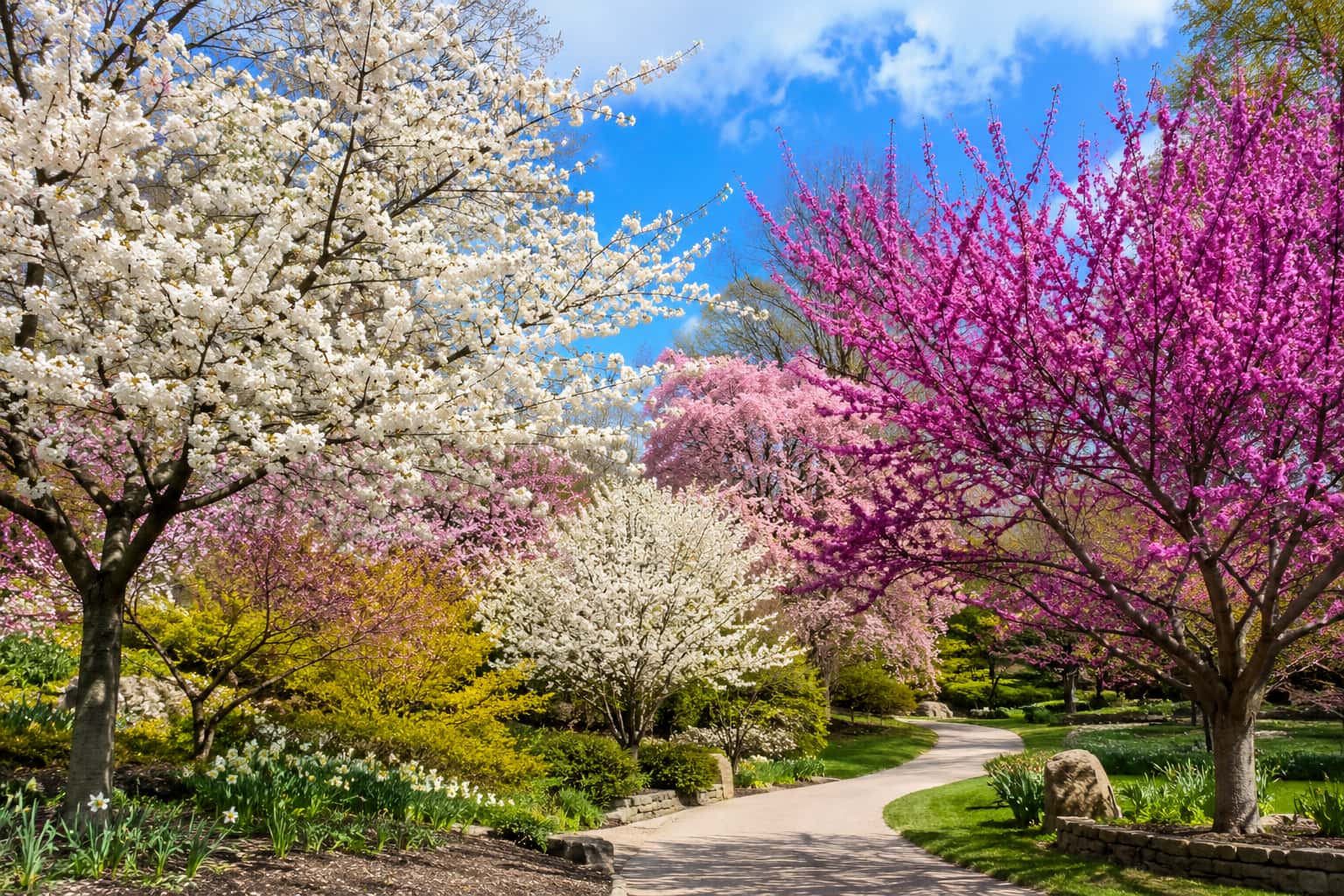
Pink flower trees are among the most popular ornamental trees for home landscapes — the soft pink tones of cherry, redbud, magnolia, and crabapple flowers create romantic, colorful spring displays. For a pink tree in the landscape, the following species are the most commonly grown and most spectacular:
Flowers on bare branches and trunk — most dramatic spring flowering tree
Large tulip-shaped flowers on bare branches. Most popular magnolia.
Cascading pink flowers on drooping branches — most romantic flowering tree
Pink version of native Dogwood — slightly less vigorous than white form
Many pink and red-flowered crabapple cultivars available — "Prairifire" is popular
Flowering peach tree — grown for spring flowers, shorter-lived than fruit peach
Flowering Trees With Unpleasant Smell — Trees With Smelly White Flowers
Not all trees with white flowers are pleasantly fragrant — some produce flowers with decidedly unpleasant odors. The most notorious tree with smelly white flowers in North America is Bradford Pear (Pyrus calleryana 'Bradford') — a widely planted ornamental tree that produces spectacular masses of white flowers in early spring but whose flowers emit a fishy, semen-like odor that many people find deeply unpleasant. Despite this significant drawback, Bradford Pear was widely planted as a street and ornamental tree from the 1950s through the 1990s, and now lines millions of streets across the eastern United States. Many municipalities now actively discourage or prohibit new Bradford Pear plantings.
Hawthorn trees (Crataegus species) produce white flowers in spring that smell distinctly unpleasant to many people — the odor has been described as rotting meat. This is an adaptation to attract flies as pollinators rather than bees. Hawthorn flowers contain trimethylamine — the same compound responsible for the smell of rotting fish. Despite this, hawthorn is an extremely valuable wildlife tree, providing food and nesting for dozens of bird species.
Pleasantly fragrant trees with white flowers include Southern Magnolia (lemon-vanilla), Black Locust (sweet grape-like), Linden/Basswood (intense honey-like — see our Linden Tree Guide), and Mock Orange (Philadelphus) — orange blossom scent. When choosing flowering trees for a garden, consider the fragrance as carefully as the flower color and bloom time.
Serviceberry — The Earliest Spring Flowering Tree
Serviceberry (Amelanchier species), also called Juneberry, Shadbush, or Saskatoon, produces white flowers earlier in spring than virtually any other ornamental tree — blooming in March or early April when snow may still be on the ground in northern regions. This early bloom makes serviceberry a critical food source for early-emerging pollinators, including queen bumblebees and early solitary bees that have just emerged from winter dormancy.
Serviceberry flowers are white, 5-petaled, and produced in drooping clusters (racemes) that cover the tree before leaves fully emerge. The flowers are lightly fragrant with a pleasant honey-like scent. Following the flowers, serviceberry produces small edible blueberry-like fruits (technically pomes) in June — hence the alternate name "Juneberry." These fruits are sweet and delicious, eaten fresh or made into pies and preserves, and are extremely attractive to birds. Serviceberry also provides excellent red to orange fall color, making it a four-season ornamental tree of high wildlife value.
Frequently Asked Questions — Trees With White Flowers
What tree has white flowers in spring?
The most common white spring flowering trees are Flowering Dogwood (April-May), Yoshino Cherry (March-April), Serviceberry (March-April, earliest), Star Magnolia (March-April), Great White Cherry, White Crabapple, and Bradford Pear. Black Locust flowers white in May-June. Southern Magnolia flowers in summer.
What is white cherry blossom?
White cherry blossom refers to flowers from ornamental cherry trees, especially Yoshino Cherry (Prunus × yedoensis) — the Washington DC cherry blossom species. Great White Cherry (Prunus "Tai Haku") is considered the most beautiful white cherry with the largest single white flowers. All produce white to very pale pink 5-petaled flowers in spring before leaves.
What tree has big white flowers?
Southern Magnolia (up to 30cm flowers) has the largest white flowers of any commonly grown tree. Star Magnolia has pure white 7-10cm star-shaped flowers. Saucer Magnolia flowers are large (up to 25cm) but usually pink-white. Catalpa has 4-5cm orchid-like white flowers with purple spots in summer.
What trees have smelly white flowers?
Bradford Pear is the most notorious tree with unpleasant smelling white flowers — fishy/chemical odor. Hawthorn flowers smell of rotting meat (attracts flies). Fragrant white flowering trees include Southern Magnolia (lemon-vanilla), Black Locust (sweet grape), and Linden (honey-like).
What is flowering dogwood?
Flowering Dogwood (Cornus florida) is native to eastern North America and produces white bracts (modified leaves, not petals) in April-May. The white "petals" have a distinctive notch at the tip. Also provides brilliant red fall color and red berries for birds. Pink Dogwood (Cornus florida f. rubra) has pink bracts.
What is a flowering peach tree?
Flowering peach trees are ornamental Prunus persica varieties grown for their spectacular double or semi-double spring flowers rather than fruit. Produce white, pink, or red flowers in March-April before leaves. Weeping peach tree is the most dramatic form with pendulous branches covered in flowers. Peach blossom is a symbol of spring in Chinese culture.
What pink flowering trees bloom in spring?
Best pink spring flowering trees: Eastern Redbud (vivid reddish-pink on bare branches), Saucer Magnolia (large pink-purple flowers), Weeping Cherry (cascading pale-mid pink), Pink Dogwood (pink bracts), and flowering pink/red Crabapples. Tree with pink blooms — Redbud is the most dramatic native option.
Identify Your Flowering Tree Instantly
Found a beautiful flowering tree and want to know the species? Upload a photo to our free AI Tree Identifier for instant identification — works from flower, leaf, bark, or full-tree photos in any season. Related guides: Trees With White Bark, Trees With Heart Shaped Leaves, Linden Tree Guide, Fast Growing Trees, Maple Tree Guide.
Species tools: Oak Tree Identifier, Maple Tree Identifier, Birch Tree Identifier, Fruit Tree Identifier, Elm Tree Identifier, Pine Tree Identifier.